Dang Boyu,Wu Huiyun,Zhang Mengfei,Duan Qingyang,Feng Zeqiang,Zhao Geng,Jing Jie. Simulation of solidification structure evolution of Cu-2.0Fe-0.03P-0.11Zn alloy continuous casting billets based on CAFE method [J]. Copper Engineering,2026(3):77-85.
Abstract
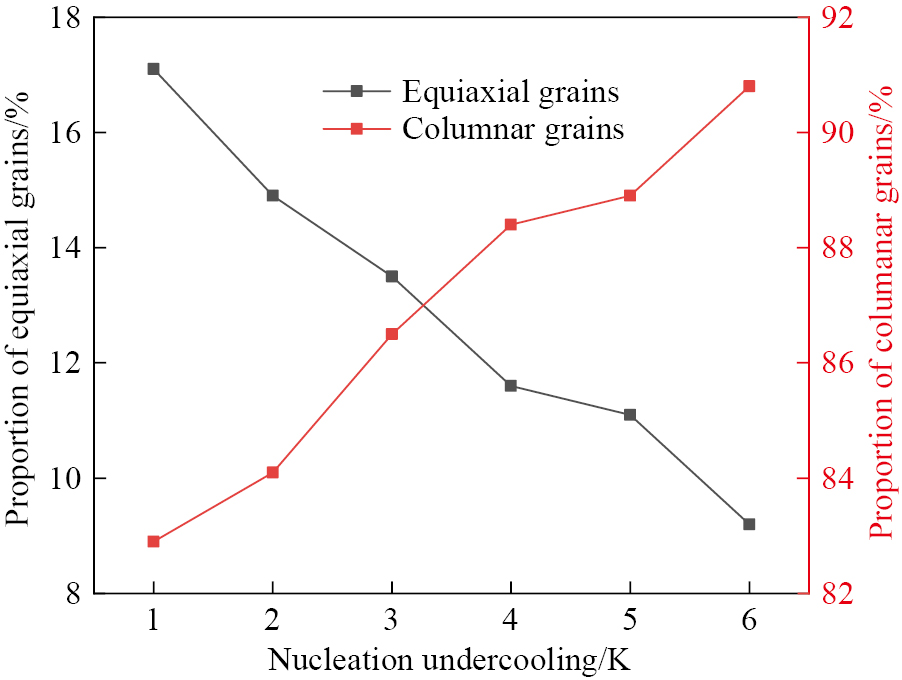
Cu-2.0Fe-0.03P-0.11Zn alloy is a promising candidate material for electrical connectors owing to the low cost and excellent castability. Continuous casting serves as a key process in strip and plate production, where the solidification microstructure strongly influences subsequent processing and final product properties. In this study, a cellular automaton-finite element (CAFE) model was developed to simulate the solidification microstructure evolution of the Cu-2.0Fe-0.03P-0.11Zn alloy under continuous casting conditions. Simulated fractions of columnar and equiaxed grains were 87.4% and 12.6%, respectively, which were in close agreement with those of experimentally measured macrostructures (88.6% and 11.4%), confirming reliability and accuracy of the established model. Further investigations were conducted on effects of nucleation undercooling and nucleation density on solidification microstructure. Results indicated that increasing nucleation undercooling reduced the proportion of equiaxed grains: as undercooling increased from 1 K to 6 K, equiaxed grain fraction decreased from 17.1% to 9.2%, respectively. In contrast, increasing nucleation density promoted equiaxed grain formation, with equiaxed grain fraction increasing from 10.4% to 18.5% as the nucleation density increased from 0.5×10⁹ m–3 to 40×109 m–3, respectively.
铜合金因具有良好的导电性和力学性能,主要应用于电子信息等领域[ 李周,肖柱,姜雁斌,等. 高强导电铜合金的成分设计、相变与制备 [J]. 中国有色金属学报,2019,29(9):2009-2049. 肖柱,丁燕军,王泽军,等. 先进铜基复合材料的研究与发展 [J]. Transactions of Nonferrous Metals Society of China,2024,34(12):3789-3821. 1-2]。目前常见的铜合金体系包括Cu-Al-Ni系[ Tian X L,Zhao Y H,Gu T,et al. Cooperative effect of strength and ductility processed by thermomechanical treatment for Cu-Al-Ni alloy [J]. Materials Science and Engineering:A,2022,849:143485. Zhang S X,Wu L,Gu T,et al. Effect of microstructure on the mechanical properties of ultrafine-grained Cu-Al-Ni alloys processed by deformation and annealing [J]. Journal of Alloys and Compounds,2022,923:166413. 3-4]、Cu-Ni-Si系[ 姜雁斌,黄承智,李周,等. 集成电路引线框架用铜合金研究现状 [J]. 铜业工程,2024(3):131-144. 5]、Cu-Cr-Zr系[ 李明茂,杨斌,王智祥. 高强高导 CuCrZr 合金熔炼技术研究 [J]. 特种铸造及有色合金,2005,25(4):252-253. Gu T,Li J W,Xu F Q,et al. Effect of high temperature-high pressure treatment on microstructure and mechanical properties of Cu-Cr alloy [J]. Materials Research Express,2020,7(2):026505. 6-7]、Cu-Fe-P系等。其中,Cu-Fe-P合金因成本低廉、加工与焊接性能优良,被广泛用于制造电连接器等关键部件,特别是Cu-2.0Fe-0.03P-0.11Zn作为一种典型的Cu-Fe-P系合金,在导电型结构件中具有较高的应用价值。Cu-2.0Fe-0.03P-0.11Zn合金电连接器的制备过程包括连铸、热轧、固溶、冷轧和多级时效等工序[ 郑济森,张峻嘉,唐天轶,等. 形变热处理工艺对 Cu-Fe-P合金组织与性能的影响 [J]. 材料与冶金学报,2023,22(5):489-494. 邵烨,刘峰,程万林,等. 端子连接器用 Cu-Fe-P-Zn-Sn-Mg合金的热变形行为 [J]. 特种铸造及有色合金,2018,38(3):342-345. 8-9],其中连铸过程的凝固组织演变对材料后续加工及最终性能具有决定性影响。由于该合金的热导率高、冷却速度快,若工艺控制不当,易出现温度梯度过大、柱状晶发达、等轴晶比例低及晶粒粗大等问题,严重影响其强度与导电性[ 王旭锋,张真豪,高绪锋,等. Cu-Fe合金凝固过程中结构变化研究 [J]. 原子与分子物理学报,2025,42(6):183-192. 10]。根据凝固理论,凝固组织与温度梯度(G)和凝固速度(R)相关,G/R比值可用于判断柱状晶—等轴晶的转变。当G/R较大时,固液界面前沿的成分过冷区较窄,柱状晶稳定生长;而当G/R减小时,异质形核作用增强,凝固组织逐渐由柱状晶向等轴晶转变[ 董琦祎,汪明朴,贾延琳,等. Cu-Fe-P-Zn合金铸态及均匀化组织 [J]. 中南大学学报(自然科学版),2012,43(12):4658-4665. 11]。因此,深入研究Cu-2.0Fe-0.03P-0.11Zn合金的凝固组织演变规律,对优化其铸造工艺和提升铸坯组织均匀性具有重要意义。
连铸过程中凝固组织的形成与演变受宏观温度场、流场以及微观溶质传输等多场耦合作用影响,其过程复杂,单纯依靠实验手段难以对组织演变行为进行全过程、可视化的揭示。相比之下,数值模拟技术能够在宏观尺度准确描述温度梯度与流动状态,在微观尺度捕捉晶粒形核、生长及竞争行为,为凝固组织调控机制研究和工艺参数优化提供了可靠的理论工具[ 崔雨薇,赵宇宏,裴小龙,等. 基于边界网格投影的铸造模拟仿真网格剖分方法 [J]. 特种铸造及有色合金,2024,44(5):614-619. 李静怡,赵宇宏,陈利文,等. 镁合金隔板铸件低压铸造工艺数值模拟 [J]. 特种铸造及有色合金,2021,41(5):588-592. 12-13]。在众多模拟方法中,CAFE(cellular automaton-finite element)模型因能够同时耦合宏观传热与微观晶粒生长行为而被广泛用于金属凝固组织预测。大量研究表明,CAFE模型不仅可再现凝固过程中柱状晶生长、等轴晶形核与柱状晶—等轴晶转变(CET)等关键组织特征,还能通过与实验对比获得较高的预测精度[ 许庆彦,柳百成. 铸造合金凝固组织的计算机模拟与预测 [J]. 稀有金属材料与工程,2003,32(6):401-406. 14]。例如,Cui等[ 崔新鹏,李峰,马静,等. Ti-6Al-4V 钛合金凝固组织的CAFE法模拟 [J]. 特种铸造及有色合金,2024,44(5):717-720. 15]利用ProCAST软件的CAFE模块,对Ti-6Al-4V钛合金阶梯试样凝固过程进行多尺度模拟,揭示了铸件表面至心部由柱状晶向等轴晶的转变规律,并通过精密铸造试验验证了模拟可靠性。率先实现了铸件宏观尺度晶粒形貌与尺寸的定量预测,平均晶粒直径模拟与试验吻合率达80%~99%,其中薄壁区域达99%。该成果突破了钛合金凝固组织预测的工程难题,为航空航天领域关键铸件工艺优化提供了低成本、高精度的数字化解决方案。Li等[ Li Y,Chang X N,Yang G Y,et al. Numerical simulation of solidification structures in continuous casting of a thin slab at high casting speed [J]. Ironmaking & Steelmaking,2023,50(1):21-29. 16]在研究高速连铸薄板坯时,将CAFE模型与实际连铸速度、过热度及结晶器冷却条件相结合,定量预测了凝固末端的CET位置、晶粒尺寸分布,并提出了优化冷却强度与拉速的工艺窗口,为工业薄板坯生产提供了重要理论依据。近年来,研究者将CAFE模型应用于Cu-Ni-Sn、Cu-Ni-Si等铜合金体系的凝固组织模拟,研究其凝固过程和组织演变规律[ Lv Z,Sun Z J,Hou Z H,et al. Numerical and experimental research on solidification of T2 copper alloy during the twin-roll casting [J]. High Temperature Materials and Processes,2022,41(1):1-7. Mouralova K,Benes L,Prokes T,et al. Analysis of the machinability of copper alloy ampcoloy by WEDM [J]. Materials,2020,13(4):893. 17-18]。相关研究为铜合金凝固过程的数值模拟与工艺优化奠定了良好的基础。然而,现有研究多集中于Cu-Ni或Cu-Sn等体系,对Cu-Fe-P合金凝固组织的模拟研究仍十分有限,尤其缺乏关于形核参数对凝固组织演变影响规律的系统性、定量化分析。鉴于Cu-Fe-P合金在电子连接器等领域的广泛应用,其连铸凝固组织的形成机理亟须深入研究。基于此,本文采用CAFE模型模拟计算Cu-2.0Fe-0.03P-0.11Zn合金在连铸过程中的凝固组织转变情况,探讨形核参数对凝固组织特征的影响,旨在为提升工业生产中Cu-Fe-P合金铸坯的质量提供科学依据。
1 模型与方法
1.1 晶粒形核模型
在本研究中,应用异质形核模型描述Cu-Fe-P合金连铸凝固中晶粒的形成情况。该模型源于Rappaz等[ Rappaz M,Gandin C A,Desbiolles J L,et al. Prediction of grain structures in various solidification processes [J]. Metallurgical and Materials Transactions A,1996,27(3):695-705. Rappaz M,Gandin C H A. Probabilistic modelling of microstructure formation in solidification processes [J]. Acta Metallurgica et Materialia,1993,41(2):345-360. 19-20]提出的连续形核模型理论,具体如公式(1)所示,而公式(1)表示了晶粒密度的变化,其中,dn/d(ΔT)与高斯分布相关,具体形式为公式(2):
式(1)
式(2)
式中:dn为晶粒密度的变化量;d(ΔT)表示某一过冷度下晶粒密度;而dn/d(ΔT)表示单位过冷度区间内晶粒密度的变化率;n为晶粒密度;nmax为最大形核密度;ΔT为过冷度;ΔTmax为最大过冷度;ΔTσ为形核过冷度标准方差[ Oldfield W. A quantitative approach to casting solidification:freezing of cast iron [J]. Transactions of the ASM,1966,59:945-964. 21]。
式中:ΔTc为成分过冷;ΔTt为热力学过冷;ΔTk为生长动力学过冷;ΔTr为固-液界面曲率过冷。对于大多数的金属材料而言,成分过冷度为主要影响因素,可以用KGT(Kurz-Giouanola-Trivedi)模型计算枝晶尖端生长速度[ Kurz W,Giovanola B,Trivedi R. Theory of microstructural development during rapid solidification [J]. Acta Metallurgica,1986,34(5):823-830. 22],如公式(4)所示:
在浇注温度1200 ℃、拉坯速度1.08×10⁻³ m/s、结晶器换热系数5000 W/(m2·K)条件下,利用数值模拟得到Cu-2.0Fe-0.03P-0.11Zn合金连铸坯凝固过程中截面组织场的演变规律,如图2所示。凝固组织演变主要受传热条件影响。随着凝固的推进,热量由熔体中心逐步向表面传递,柱状晶沿热流方向的反向由表面向心部生长,并通过竞争生长机制吞并取向不利的晶粒[ Yang J J,Yu H C,Yang H H,et al. Prediction of microstructure in selective laser melted Ti-6Al-4V alloy by cellular automaton [J]. Journal of Alloys and Compounds,2018,748:281-291. 23]。随着连铸坯芯部区域温度持续降低,柱状晶凝固前沿局部过冷度达到临界形核条件,诱发大量晶核产生。同时中心熔体温度梯度差异小,使晶粒自由生长形成芯部等轴晶区[ Jia H M,Feng X H,Yang Y S. Microstructure evolution and growth orientation of directionally solidified Mg-4 wt% Zn alloy with different growth rates [J]. Acta Metallurgica Sinica (English Letters),2017,30(12):1185-1191. 24]。
图2 模拟连铸坯横截面凝固组织场演变过程
Fig. 2 Evolution of solidification microstructure field in the cross-section of simulated continuous casting billet:(a) 3 s;(b) 7 s;(c) 41 s;(d) 77 s;(e) 130 s
Fig. 5 SEM morphology and EDS analysis of the center of Cu-2.0Fe-0.03P-0.11Zn alloy billet:(a) SEM image;(b~f) Elemental distribution;(g) EDS spectrum at point a,(h) EDS spectrum at point b
Fig. 8 Microstructure field of the billet under different nucleation densities:(a) 0.5×10⁹ m−3;(b) 1×10⁹ m−3;(c) 3×10⁹ m−3;(d) 7×10⁹ m−3;(e) 20×109 m−3;(f) 40×109 m−3
图9 形核密度与等轴晶、柱状晶面积占比的关系
Fig. 9 Relationship between nucleation density and area fractions of equiaxed and columnar grains
肖柱,丁燕军,王泽军,等. 先进铜基复合材料的研究与发展 [J]. Transactions of Nonferrous Metals Society of China,2024,34(12):3789-3821.
[3]
TianX L,ZhaoY H,GuT,et al. Cooperative effect of strength and ductility processed by thermomechanical treatment for Cu-Al-Ni alloy [J]. Materials Science and Engineering:A,2022,849:143485.
[4]
ZhangS X,WuL,GuT,et al. Effect of microstructure on the mechanical properties of ultrafine-grained Cu-Al-Ni alloys processed by deformation and annealing [J]. Journal of Alloys and Compounds,2022,923:166413.
GuT,LiJ W,XuF Q,et al. Effect of high temperature-high pressure treatment on microstructure and mechanical properties of Cu-Cr alloy [J]. Materials Research Express,2020,7(2):026505.
LiY,ChangX N,YangG Y,et al. Numerical simulation of solidification structures in continuous casting of a thin slab at high casting speed [J]. Ironmaking & Steelmaking,2023,50(1):21-29.
[17]
LvZ,SunZ J,HouZ H,et al. Numerical and experimental research on solidification of T2 copper alloy during the twin-roll casting [J]. High Temperature Materials and Processes,2022,41(1):1-7.
[18]
MouralovaK,BenesL,ProkesT,et al. Analysis of the machinability of copper alloy ampcoloy by WEDM [J]. Materials,2020,13(4):893.
[19]
RappazM,GandinC A,DesbiollesJ L,et al. Prediction of grain structures in various solidification processes [J]. Metallurgical and Materials Transactions A,1996,27(3):695-705.
[20]
RappazM,GandinC H A. Probabilistic modelling of microstructure formation in solidification processes [J]. Acta Metallurgica et Materialia,1993,41(2):345-360.
[21]
OldfieldW. A quantitative approach to casting solidification:freezing of cast iron [J]. Transactions of the ASM,1966,59:945-964.
[22]
KurzW,GiovanolaB,TrivediR. Theory of microstructural development during rapid solidification [J]. Acta Metallurgica,1986,34(5):823-830.
[23]
YangJ J,YuH C,YangH H,et al. Prediction of microstructure in selective laser melted Ti-6Al-4V alloy by cellular automaton [J]. Journal of Alloys and Compounds,2018,748:281-291.
[24]
JiaH M,FengX H,YangY S. Microstructure evolution and growth orientation of directionally solidified Mg-4 wt% Zn alloy with different growth rates [J]. Acta Metallurgica Sinica (English Letters),2017,30(12):1185-1191.