Research Status and Application Prospects of Cd1-xZnxTe (0≤x≤1) Crystals
Citations
Zhu Song,Hao Jian,Huai Yangyang,Zhang Qingli,Tao Xiaodong,Hu Siqi,Wang Xiaofei,Chen Feipeng. Research status and application prospects of Cd1-xZnxTe (0≤x≤1) crystals[J]. Copper Engineering,2026(3):48-58.
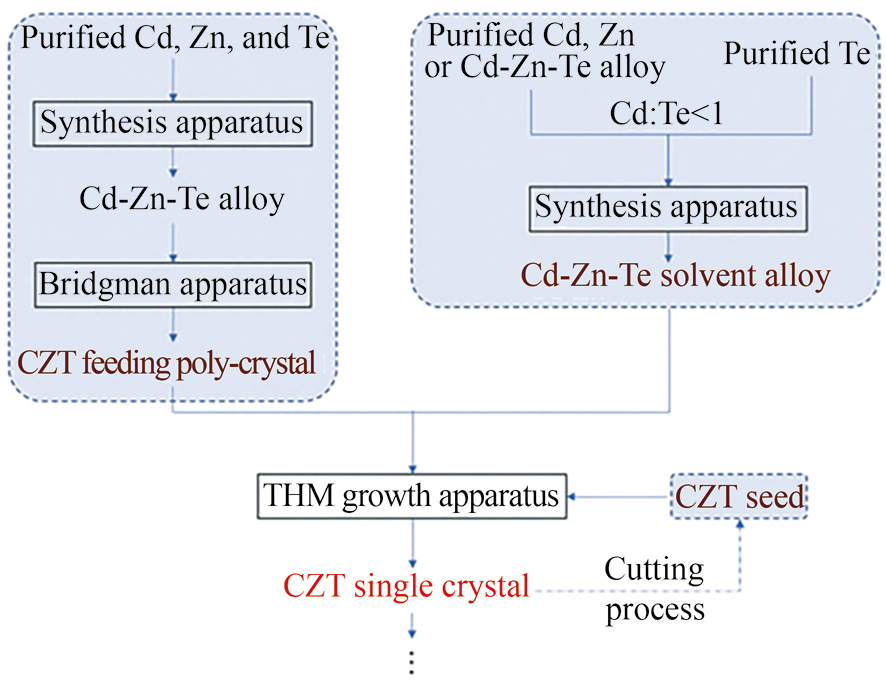
图1 CZT晶体THM生长示意图
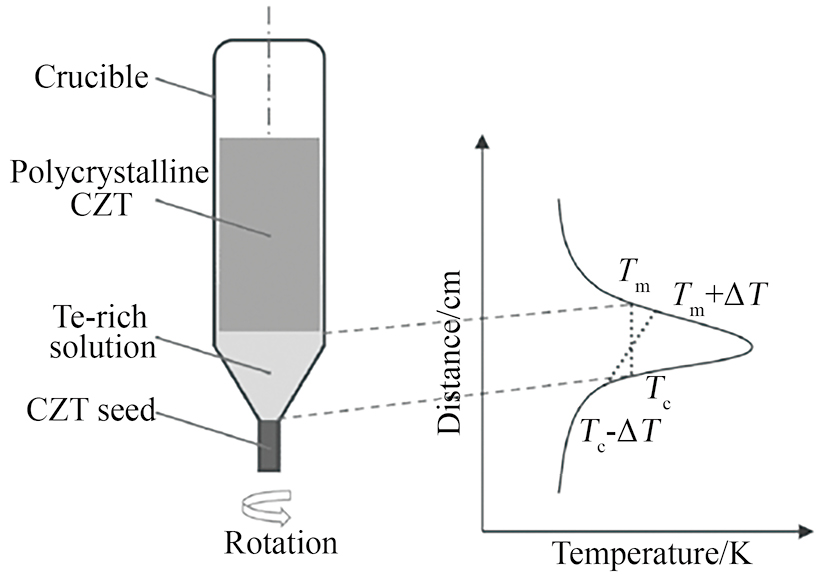
图2 THM溶质传输过程示意图
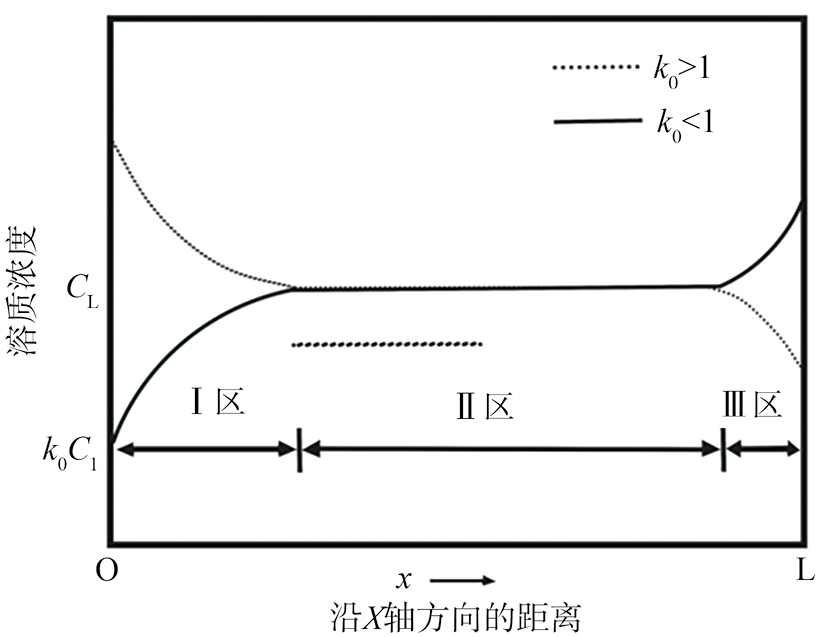
图3 THM理论上溶质分布示意图
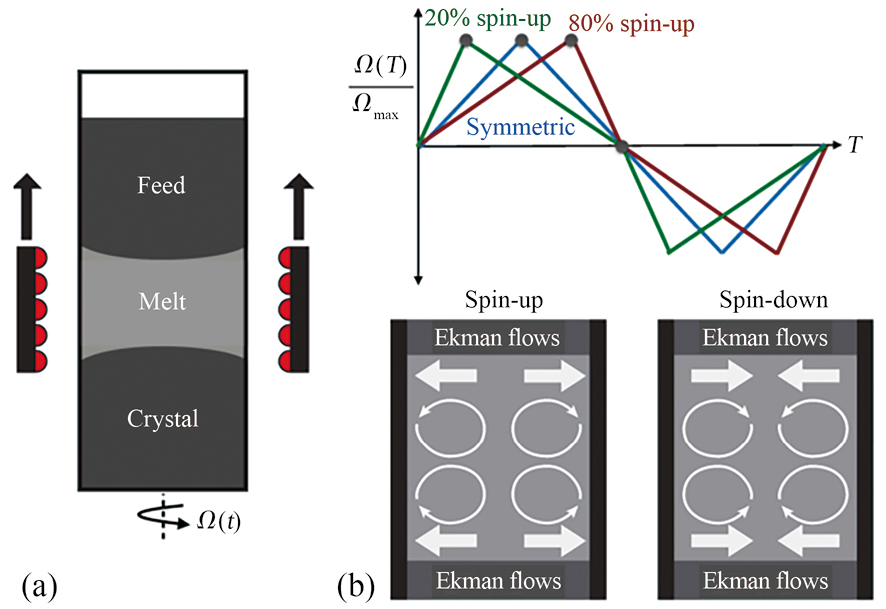
图4 (a)THM示意图;(b)加速旋转期间向外的Ekman流动和减速期间向内的Ekman流动
图5 基于ACRT生长界面形貌稳定性对结晶质量的影响:(a) CZT晶锭;(b)Ⅰ区域的红外成像图
图6 基于原料掺杂调控的缺陷预补偿技术路线
图7 基于原位降温退火的缺陷消除技术路线
图8 基于气氛掺杂退火的缺陷后补偿技术路线
图9 CZT X射线探测器的应用:(a)资源勘探;(b)医学影像;(c)无损检测;(d)国土安全
表1 各类探测器对比
表2 各类CZT晶体生长方法对比
铜业工程 第3期 48-58
doi:10.3969/j.issn.1009-3842.2026.03.006
材料制备与加工工程(Material Preparation and Process Engineering)
1.Jiangxi Copper Technology Institute Co.,Ltd.,Nanchang330096,China
2.Hefei Institutes of Physical Science,Chinese Academy of Sciences,Hefei230031,China
Citations
Zhu Song,Hao Jian,Huai Yangyang,Zhang Qingli,Tao Xiaodong,Hu Siqi,Wang Xiaofei,Chen Feipeng. Research status and application prospects of Cd1-xZnxTe (0≤x≤1) crystals[J]. Copper Engineering,2026(3):48-58.
Abstract
Depletion of high-grade ore deposits, coupled with growing difficulty of separating low-grade ores, has exposed critical shortcomings in current ore separation technologies: sluggish response, high energy consumption, and elevated noise at room temperature. The advent of third-generation semiconductors has positioned Cd1-xZnxTe (0≤x≤1, abbreviated as CZT) as a highly efficient detector material. Leveraging an innovative single-step conversion mechanism, Cd1-xZnxTe (0≤x≤1) detectors directly transduce high-energy radiation into charge signals, enabling precise determination of energy, position and time. This paper provided a comprehensive survey of worldwide research on Cd1-xZnxTe (0≤x≤1) crystals, systematically comparing the merits and drawbacks of various growth techniques. Detailed assessments were presented on controlling compositional uniformity, managing the solid-liquid interface, and eliminating—or at least mitigating—bulk and surface defects. Building on these analyses, the outlook for future applications and development trajectories of Cd1-xZnxTe (0≤x≤1) crystals was discussed.
近年来,随着高品位矿石资源的不断减少和低品位矿石分选难度的增加,现有的矿石分选设备、工艺面临着能耗成本高(增加35%~50%)、预抛废效率低(<60%)、尾矿产生量多(>40%)等问题。为此,新一代的X射线透射技术矿石智能分选装备凭借其测量精度高、响应速度快、分辨率高等特点,在鞍钢集团、北京霍里思特、赣州好朋友、湖南军芃科技等企业得到广泛应用[ 耿志强,吴启明,江国华,等. XRT智能预选技术在有色金属矿山中的应用进展 [J]. 铜业工程,2023(5):119-126. Li X Q,Liu A X,Chen J H,et al. Design and technical research of intelligent maintenance support system of engineering equipment [C]//Proceedings of the 1st International Conference on Maintenance Engineering. Chengdu,China,2006:156-160. Robben C,de Korte J,Wotruba H,et al. Experiences in dry coarse coal separation using X-ray-transmission-based sorting [J]. International Journal of Coal Preparation and Utilization,2014,34(3/4):210-219. 吴文奇,徐涛,郝倩,等. 中国稀土X射线荧光分析的应用 [J]. 中国稀土学报,2010,28(1):30-36. 1-4]。
X射线透射技术基于各种元素对光子的吸收和散射差异,可以分析出矿石的内部成分和结构等特征。例如,当80~150 keV能谱的X射线穿过矿石时,高原子序数元素[如铜(Cu)、铁(Fe)等]因光电效应产生的吸收信号可达低原子序数元素[如硅(Si)、铝(Al)]的103倍量级,这使得X射线透射技术相较于光学分选,能够显著提升矿石品位的辨识精度[ Ahmed S N. Physics and engineering of radiation detection [M]. Amsterdam:Academic Press,2007. Ahmad M I,Ab Rahim M H,Nordin R,et al. Ionizing radiation monitoring technology at the verge of Internet of Things [J]. Sensors,2021,21(22):7629. Toldrá F. Irradiation of food commodities:techniques,applications,detection,legislation,safety and consumer opinion [J]. Trends in Food Science & Technology,2011,22(1):50. 刘龙繁,曾磊,陈串串,等. 矿石光电分选系统的设备树构建及智能运维应用 [J]. 铜业工程,2025(2):1-9. 伍琨,戚光荣. 江西某钨矿智能抛废工艺探索试验与生产应用 [J]. 中国钨业,2022,37(4):67-72. 5-9]。
在矿石智能分选装备领域,X射线透射技术聚焦于半导体探测器、闪烁体探测器及光电倍增管(PMT)等类型(表1)。探测器材料通常可分为半导体材料和闪烁体材料。单质半导体材料如单质硅和高纯锗,具有不同的探矿特点。单质硅探测器仅对低能X射线(1~20 keV)具有较高的能量分辨率,适合铝(Al)、镁(Mg)等轻金属矿的快速普查,但在高能射线(>50 keV)探测中效率骤降至1%以下。高纯锗探测器的能量分辨率约0.1%~0.3%,可覆盖1 keV~10 MeV宽能谱范围,能精确检测贵金属特征射线[金(Au):9.71 keV;银(Ag):22.1 keV]和放射性核素[铀(U):1.001 MeV;钍(Th):2.614 MeV]。然而,高纯锗探测器依赖液氮或机械制冷系统维持-196 ℃的低温,设备体积较大,不适合野外探矿的应用。相比之下,闪烁体材料[如碘化钠(NaI)、硅酸钇镥(LYSO)、碘化铯(CsI)和硫氧化钆(Gd2O2S)]探测器搭配光电倍增管(PMT)可大幅提高能谱测量范围(10 keV~10 MeV),但其能量分辨率较低(7%~10%)。特别是对能量相近的Cu(8.04 keV)与Fe(6.40 keV)射线产生能谱重叠,无法进行有效区分,仅适合大规模、低精度地粗筛大体积的高品位矿石(如Cu品位>1%的矿石),且难以定位铜铁矿的精细结构[ 印万忠,吴尧,韩跃新,等. X射线辐射分选原理及应用 [J]. 中国矿业,2011,20(12):88-92. Milbrath B D,Peurrung A J,Bliss M,et al. Radiation detector materials:an overview [J]. Journal of Materials Research,2008,23(10):2561-2581. Enlow E,Abbaszadeh S. State-of-the-art challenges and emerging technologies in radiation detection for nuclear medicine imaging:a review [J]. Frontiers in Physics,2023,11:1106546. 韩跃新,王泽红,陈晓龙. X射线辐射分选技术及设备的发展与应用 [J]. 矿产综合利用,2013,34(6):11-15. 罗辉,鲁重凯,肖罡. 面向智能光电分选的检测与决策方法研究 [J]. 铜业工程,2025(2):27-37. Damulira E. Radiation dosimetry in medicine using Ⅱ-Ⅵ semiconductors [J]. Journal of Radiation Research and Applied Sciences,2022,15(3):72-82. 10-15]。
表1 各类探测器对比
Table 1 Comparison of various detectors
名称
种类
工作原理
能量分辨率
适用能区
优势场景
局限性
单质硅探测器
单质半导体探测器
半导体电离
0.1%~0.5%
1~20 keV
轻金属矿普查、便携设备
高能射线探测效率低
高纯锗探测器
单质半导体探测器
半导体电离
0.1%~0.3%
1 keV~10 MeV
贵金属/放射性矿痕量分析
须低温(-196 ℃)、成本高昂
CZT探测器
半导体探测器
半导体电离
0.5%~6%
5 keV~3 MeV
中低品位矿分选、微观成像
晶体生长成本高(占设备的30%~40%)
无机/有机闪烁体探测器
闪烁体探测器
闪烁发光+光电转换
7%~10%
10 keV~10 MeV
高品位矿粗筛、大体积探测
分辨率不足、误判率高
作为第三代前沿战略性半导体材料,碲锌镉(Cd1-xZnxTe,0≤x≤1,简称CZT)晶体是最具有应用前景的室温探测材料之一。与传统的闪烁体材料不同,CZT探测器采用创新的一步转换技术,直接将高能射线转化为电荷信号,实现对射线能量、位置及时间的精准测量,可极大程度地复原矿石的成分、密度和形状等本征信息。在X射线矿石资源探测领域,CZT矿石分选设备已进入示范性应用阶段。相较于传统分选设备仅依赖密度信息,因而难以有效区分原子序数相近元素(如Cu与Fe)的局限性,CZT探测器基于能谱分析技术,可实现相近元素的高精度识别与实时分选,可显著提升分选的准确性与效率。CZT探测器的能量分辨率为0.5%~2%,能够清晰分离Cu与Fe的能谱峰(ΔE=1.64 keV),实现0.3%~0.5%品位差异的检测,最低可检测含0.3%Cu的低品位矿石。例如,在紫金矿业铜矿分选中,CZT矿石分选设备通过能谱阈值分割算法,将Cu品位0.5%的矿石检出率提升至85%。该探测器能够区分黄铜矿(CuFeS2)与黄铁矿(FeS2),可实现对铜铁矿与伴生矿的高效分离[ Xu Y L,Lin Q Q. Photodetectors based on solution-processable semiconductors:recent advances and perspectives [J]. Applied Physics Reviews,2020,7:011315. Antonis P D. The first steps in solid-state X-ray imaging:the structure and electronic properties of cadmium zinc telluride radiation detectors [J]. Journal of Materials Science:Materials in Electronics,1998,9(4-5):331-340. Hubert C M,Cook W R. Hard X-ray imaging detectors onboard the balloon-borne high-energy focusing telescope [A]//Semiconductor Radiation Detection Systems [M]. Boca Raton,FL:CRC Press,2010:137–140. Zhan Z Y,Zheng L X,Pan Y Z,et al. Self-powered,visible-light photodetector based on thermally reduced graphene oxide–ZnO (rGO–ZnO) hybrid nanostructure [J]. J Mater Chem,2012,22(6):2589-2595. Kharatzadeh A,Jamali-Sheini F,Yousefi R. Excellent photocatalytic performance of Zn(1–x)MgxO/rGO nanocomposites under natural sunlight irradiation and their photovoltaic and UV detector applications [J]. Materials & Design,2016,107:47-55. Koppens F H L,Mueller T,Avouris P,et al. Photodetectors based on graphene,other two-dimensional materials and hybrid systems [J]. Nature Nanotechnology,2014,9(10):780-793. Liu Y,Cheng R,Liao L,et al. Plasmon resonance enhanced multicolour photodetection by graphene [J]. Nature Communications,2011,2:579. 16-22]。
CZT晶体的生长方法主要有三种:垂直梯度凝固法(VGF)、坩埚下降法(VB)、移动加热器法(THM)等[ Xu C,Zhang J,Zhou C H,et al. Advancements in Iso-Diameter seeded growth of CdZnTe crystals:a numerical modeling approach and applications in liquid phase epitaxy [J]. Journal of Crystal Growth,2024,633:127670. Neubert M,Jurisch M. Transient segregation behavior in Cd1–xZnxTe with low Zn content—a qualitative and quantitative analysis [J]. Journal of Crystal Growth,2015,420:101-108. McCoy J J,Kakkireni S,Gilvey Z H,et al. Overcoming mobility lifetime product limitations in vertical bridgman production of cadmium zinc telluride detectors [J]. Journal of Electronic Materials,2019,48(7):4226-4234. Sen S,Stannard J E. Developments in the bulk growth of Cd1−xZnxTe for substrates [J]. Progress in Crystal Growth and Characterization of Materials,1994,29(1/2/3/4):253-273. Li G Q,Zhang X L,Hua H,et al. A modified vertical Bridgman method for growth of high-quality Cd1−xZnxTe crystals [J]. Journal of Electronic Materials,2005,34(9):1215-1224. El Mokri A,Triboulet R,Lusson A,et al. Growth of large,high purity,low cost,uniform CdZnTe crystals by the “cold travelling heater method” [J]. Journal of Crystal Growth,1994,138(1/2/3/4):168-174. Zhou B R,Jie W Q,Wang T,et al. Modification of growth interface of CdZnTe crystals in THM process by ACRT [J]. Journal of Crystal Growth,2018,483:281-284. 上官旻杰,袁文辉,梁红昱,等. VB法生长CdZnTe晶体的放肩角度优化 [J]. 激光与红外,2023,53(10):1555-1561. 李尚书,徐超. 基于移动加热器法的碲锌镉晶体研究进展 [J]. 红外,2024,45(11):1-12. 23-31]。这些方法各有优缺点(表2)。
表2 各类CZT晶体生长方法对比
Table 2 Comparison of various CZT crystal growth methods
生长方法
坩埚变速旋转(ACRT)
温场设置/℃
温度梯度/(K/cm)
最大生长速率/(mm/h)
文献
VGF
无
1115~1140
2~4
0.4
[ Xu C,Zhang J,Zhou C H,et al. Advancements in Iso-Diameter seeded growth of CdZnTe crystals:a numerical modeling approach and applications in liquid phase epitaxy [J]. Journal of Crystal Growth,2024,633:127670. 23]
VB
无
1125
4
1
[ Neubert M,Jurisch M. Transient segregation behavior in Cd1–xZnxTe with low Zn content—a qualitative and quantitative analysis [J]. Journal of Crystal Growth,2015,420:101-108. 24]
VB
有
1145~1180
20
2
[ McCoy J J,Kakkireni S,Gilvey Z H,et al. Overcoming mobility lifetime product limitations in vertical bridgman production of cadmium zinc telluride detectors [J]. Journal of Electronic Materials,2019,48(7):4226-4234. 25]
VB
无
1110
5
0.5
[ Sen S,Stannard J E. Developments in the bulk growth of Cd1−xZnxTe for substrates [J]. Progress in Crystal Growth and Characterization of Materials,1994,29(1/2/3/4):253-273. 26]
VB
有
1150
13
1
[ Li G Q,Zhang X L,Hua H,et al. A modified vertical Bridgman method for growth of high-quality Cd1−xZnxTe crystals [J]. Journal of Electronic Materials,2005,34(9):1215-1224. 27]
THM
无
850
37
0.3
[ El Mokri A,Triboulet R,Lusson A,et al. Growth of large,high purity,low cost,uniform CdZnTe crystals by the “cold travelling heater method” [J]. Journal of Crystal Growth,1994,138(1/2/3/4):168-174. 28]
THM
有
800~930
45
0.2
[ Ohmori M,Iwase Y,Ohno R. High quality CdTe and its application to radiation detectors [J]. Materials Science and Engineering:B,1993,16(1/2/3):283-290. 45]
Fig. 1 Schematic diagram of CZT crystals growth based on THM
2.2 溶质传输过程中的组分均匀性控制
如图2所示,在基于CZT晶体的THM生长溶质传输过程中,富Te熔区主要负责将溶质从溶解界面传输到生长固-液界面。Sell等[ Sell H E,Müller G. Numerical modelling of the growth and composition of Gax In1-x as bulk mixed crystals by the travelling heater method [J]. Journal of Crystal Growth,1989,97(1):194-200. 35]通过数值模拟,对THM晶体富Te熔区成分进行优化,实现了对溶质传输过程中均匀性的控制。Peterson等[ Peterson J H,Fiederle M,Derby J J. Analysis of the traveling heater method for the growth of cadmium telluride [J]. Journal of Crystal Growth,2016,454:45-58. 36]通过模拟计算富Te熔区的长度,控制生长界面附近的反向涡流,以实现溶质的稳定输运时,发现溶质传输过程产生的对流会干扰生长界面的稳定性,进而降低溶质分布的均匀性。张继军等[ Zhang J J,Qi Y W,Liu W P,et al. The effect of Te solution volume on the growth of CdZnTe crystals by traveling heater method [J]. Journal of Crystal Growth,2024,633:127647. Zhang J J,Liu W P,Wei J J,et al. Investigation of the diffusion and crystal growth of CdZnTe in Te solution using the traveling heater method under axial static magnetic field [J]. CrystEngComm,2025,27(5):644-652. 37-38]指出,THM中的较长熔区能够在溶解界面附近形成一个具有混匀作用的涡流,有助于溶质在径向分布得更加均匀,但涡流的影响规律仍需要进一步探索。
图2 THM溶质传输过程示意图
Fig. 2 Schematic diagram of solute transport during THM processes
2.3 溶质析出过程的组分均匀性控制
籽晶的引入对溶质析出过程中组分的均匀性具有显著影响[ Chen H,Awadalla S A,Iniewski K,et al. Characterization of large cadmium zinc telluride crystals grown by traveling heater method [J]. Journal of Applied Physics,2008,103:014903. 39]。Roy等[ Roy U N,Weiler S,Stein J,et al. Zinc mapping in THM grown detector grade CZT [J]. Journal of Crystal Growth,2012,347(1):53-55. 40]研究表明,采用THM生长CZT晶体时,若不使用籽晶,晶锭头部20 mm区域的Zn组分分布呈现逐渐下降趋势,这与分配系数k0>1时的分布特征极为相似,如图3所示。当引入籽晶后,CZT晶锭中Zn组分的分布均匀性得到显著提升,未出现类似Ⅰ区的分布。目前,对于溶质析出过程中的溶质浓度、平衡分配系数、生长固-液界面移动距离、多晶料中溶质浓度、熔区长度等关键因素,仍缺乏系统的研究和理论支撑。
图3 THM理论上溶质分布示意图
Fig. 3 Theoretical solute distribution diagram for THM
综上,在CZT晶体的THM生长过程中,多晶料、富Te熔区以及籽晶组织的均匀性问题严重影响了后续晶体生长的质量。为此,国内外众多学者在溶解过程、溶质传输过程以及溶质析出过程等方面开展了大量研究[ Chen H,Awadalla S A,MacKenzie J,et al. Characterization of traveling heater method (THM) grown Cd0.9Zn0.1Te [J]. IEEE Transactions on Nuclear Science,2007,54(4):811-816. 41]。然而,对于CZT晶体组分均匀性的控制方法,目前仍需针对以下关键问题进行系统性研究与精确调控:一是多晶料的组分均匀性和化学计量比的精确控制;二是富Te熔区的高度与直径比的优化;三是籽晶引入溶质浓度梯度的调控。
3 基于THM的固-液界面控制
3.1 基于无籽晶THM固-液控制的研究
曹聪等[ 曹聪,刘江高,范叶霞,等. 碲锌镉晶体生长温度梯度与界面形状稳定性关系的研究 [J]. 人工晶体学报,2024,53(4):641-648. 42]基于有限元模拟技术,发现VB相较于VGF更容易获得高温度梯度和稳定的晶体生长固-液界面。THM与VGF和VB相比,所需的生长温度更低,温度梯度更大,有利于维持生长界面的稳定[ Szeles C,Cameron S E,Soldner S A,et al. Development of the high-pressure electro-dynamic gradient crystal-growth technology for semi-insulating CdZnTe growth for radiation detector applications [J]. Journal of Electronic Materials,2004,33(6):742-751. Wang T,Jie W Q,Xu Y D,et al. Characterization of CdZnTe crystal grown by bottom-seeded Bridgman and Bridgman accelerated crucible rotation techniques [J]. Transactions of Nonferrous Metals Society of China,2009,19:s622-s625. 43-44]。THM法的特征在于坩埚位置保持固定,通过向上移动加热器来控制固-液界面,促使富Te熔区在生长界面的下端结晶。1993年,Ohmori等[ Ohmori M,Iwase Y,Ohno R. High quality CdTe and its application to radiation detectors [J]. Materials Science and Engineering:B,1993,16(1/2/3):283-290. 45]利用无籽晶的THM法,成功获得稳定的富Te熔区固-液界面,生长出直径为32 mm、长度为80 mm的高电阻率辐射探测器用CZT晶锭。
3.2 基于有籽晶THM固-液控制的研究
1999年,日本Acrorad公司采用有籽晶的THM法,成功控制籽晶熔接处的固-液界面,生长出直径为50 mm的二元碲化镉单晶,为利用THM法生长三元CZT单晶提供了理论基础。2008年,加拿大Redlen公司通过有籽晶THM法,成功获得稳定的微凸固-液界面,生长出直径约7.62 cm(3 in)的高阻值CZT单晶,并成功实现了产业化。尽管THM法在CZT晶体生长中取得了一定进展,但仍面临诸多挑战[ Funaki M,Ozaki T,Satoh K,et al. Growth and characterization of CdTe single crystals for radiation detectors [J]. Nuclear Instruments and Methods in Physics Research Section A:Accelerators,Spectrometers,Detectors and Associated Equipment,1999,436(1/2):120-126. Li G Q,Jie W Q,Gu Z,et al. Correlation between the x value and qualities of Cd1−x Znx Te crystal grown by vertical Bridgman method [J]. Materials Science and Engineering:B,2004,107(2):172-175. 46-47]。2022年,张嘉泓等[ 张嘉泓,张继军,王林军,等. 移动加热器法生长碲锌镉晶体的组分输运与界面形貌研究 [J]. 人工晶体学报,2022,51(6):973-985. 48]通过Comsol软件建立CZT晶体THM法生长模型,发现当温度梯度和生长速率较大时,熔体对流显著增强,产生次生涡旋,导致固-液界面呈现凹陷形态。这种固-液界面形态会引发CZT晶体两侧多晶的生长,从而限制THM法生长速率的进一步提高。
4 基于坩埚变速旋转(ACRT)的固-液界面控制
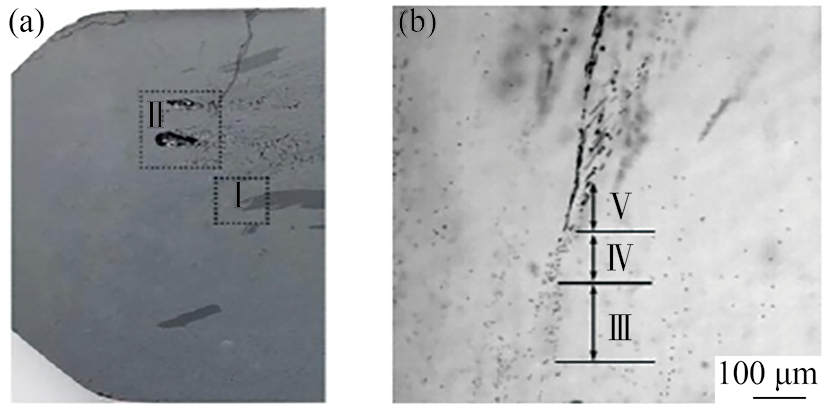
坩埚变速旋转(ACRT)是一种通过周期性改变旋转速率来调控流体对流的技术,能够更好地稳定熔体对流,在单晶生长的固-液界面控制中已得到广泛应用。1994年,Muhlbeg等[ Mühlberg M,Rudolph P,Genzel C,et al. Crystalline and chemical quality of CdTe and Cd1-x Znx Te grown by the Bridgman method in low temperature gradients [J]. Journal of Crystal Growth,1990,101(1/2/3/4):275-280. 49]首次将ACRT引入移动加热器法中,成功制备出了直径为52 mm的CZT晶锭。Triboulet等[ Triboulet R. Crystal growth by traveling heater method[M]//Handbook of crystal growth. Amsterdam:Elsevier,2015:459-504. 50]研究发现,固-液界面对流是THM中物质传输的主要机制,表明采用ACRT是合理的。该技术通过在固-液界面施加强制对流机制,使界面形态趋于平稳或微凸,获得了具有极好轴向和径向均匀性的CZT晶锭。Peterson等[ Peterson J H,Cosenza Z,Derby J J. Stability-based optimization of ACRT for the growth of CZT by the traveling heater method [J]. Journal of Crystal Growth,2022,579:126446. 51]通过数值模拟研究干扰振幅对ACRT-THM固-液界面的影响[图4(a)],发现固-液界面中Ekman流动比Taylor-Görtler流动更能有效降低熔体过冷度。这些方案取消了ACRT中的稳速旋转段,并采用较低的峰值转速,从而减小了加速阶段积累的转动惯量,在减速时可有效避开Taylor-Görtler流动不稳定性,同时突出Ekman流动的作用[图4(b)]。近年来,国内也开始重视CZT晶体材料的开发,但晶体单晶率较低,仍处于小规模晶体生产阶段。直至2018年,周伯儒等[ Zhou B R,Jie W Q,Wang T,et al. Growth and characterization of detector-grade Cd0.9Zn0.1Te crystals by the traveling heater method with the accelerated crucible rotation technique [J]. Journal of Electronic Materials,2018,47(2):1125-1130. 52]采用籽晶辅助ACRT-THM法成功生长出直径为53 mm、体积超过220 cm3的CZT单晶,但生长速率有待提高。该研究利用红外成像显微镜对图5(a)中的Ⅰ区域进行了观察,发现在THM法生长CZT晶体过程中,因Te溶剂富集引发的成分过冷会促使胞状界面形成,进而诱发Te夹杂相、孔洞及晶界等缺陷。如图5(b)所示,随着成分过冷加剧,生长界面失稳:Ⅴ区域界面变得凹凸不平,Ⅲ区域的Te夹杂相增多,Ⅳ区域甚至有新晶核形成。
图4 (a)THM示意图;(b)加速旋转期间向外的Ekman流动和减速期间向内的Ekman流动
Fig. 4 (a) Schematic diagram of THM;(b) Outward Ekman flow during acceleration and inward Ekman flow during deceleration
图5 基于ACRT生长界面形貌稳定性对结晶质量的影响:(a) CZT晶锭;(b)Ⅰ区域的红外成像图
Fig. 5 Influence of interface morphology stability on crystalline quality under ACRT growth:(a) CZT ingot cut along the growth axis;(b) IR image of the region Ⅰin figure (a)
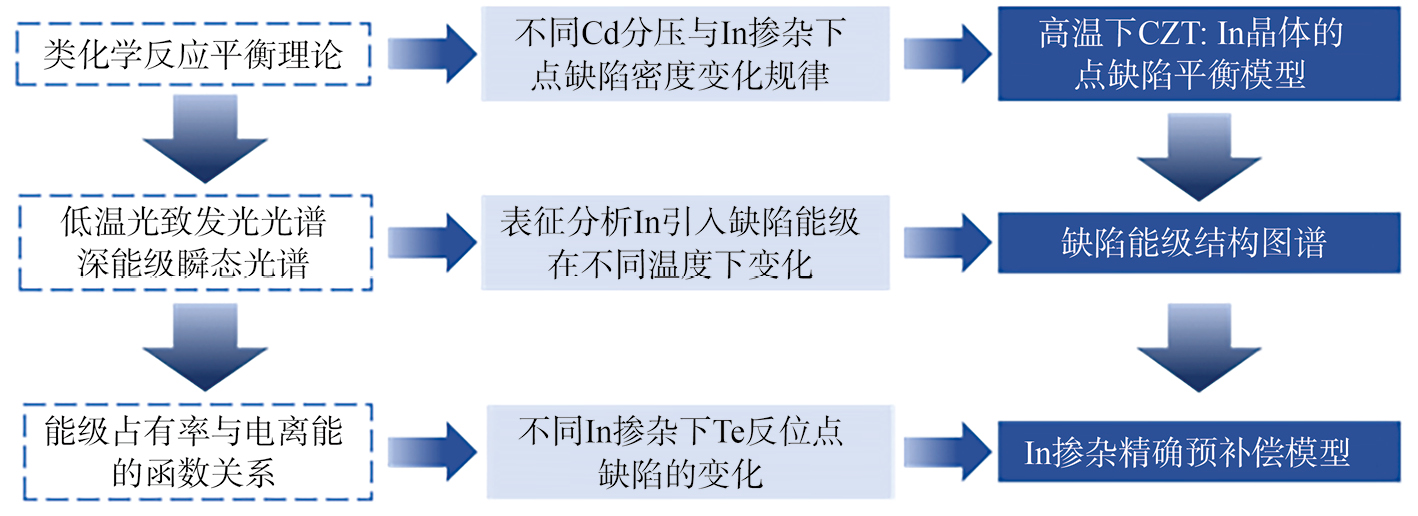
在晶体生长前,CZT晶体因其非同成分挥发特性,容易在生长态晶体中形成大量Cd空位,即使采用高纯度原材料,也难以生长出高电阻率的晶体。在生长原料中引入杂质进行掺杂补偿(图6),尤其是对本征点缺陷中的Cd进行调控,是提高晶体电阻率的有效方法。Verger等[ Verger L,Baffert N,Rosaz M,et al. Characterization of CdZnTe and CdTe:Cl materials and their relationship to X-and γ-ray detector performance [J]. Nuclear Instruments and Methods in Physics Research Section A:Accelerators,Spectrometers,Detectors and Associated Equipment,1996,380(1/2):121-126. 53]通过THM制备出CdTe:Cl晶体,成功将电阻率提高至109 Ω·cm。Thio等[ Thio T,Bennett J W,Chadi D J,et al. DX centres in CdZnTe:Cl and their applications [J]. Journal of Crystal Growth,1996,159(1/2/3/4):345-349. 54]则通过VB制备出了大尺寸CZT:Cl晶体,其光电导率和霍尔结果显示,Cl掺杂主要引入了两种深能级中心。Zerrai等[ Zerrai A,Dammak M,Marrakchi G,et al. Investigation of deep levels in vanadium-doped CdTe and CdZnTe [J]. Journal of Crystal Growth,1999,197(3):729-732. 55]通过VB制备出CZT:V晶体,研究发现V的掺杂在禁带中引入了0.65 eV和0.95 eV两个深能级,从而显著提高了晶体的电阻率。Panchuk等[ Panchuk O,Savitskiy A,Fochuk P,et al. Ⅳ group dopant compensation effect in CdTe [J]. Journal of Crystal Growth,1999,197(3):607-611. 56]使用Ⅳ元素的Ge和Sn进行掺杂,产生了快速和慢速复合中心。其中,慢速复合中心的能级接近能带中央,这种复合中心与本征缺陷之间的掺杂补偿机制,使得电阻率提高至1010 Ω·cm。同时发现,向CZT晶体中掺入In杂质能够显著提升电阻率和增加载流子寿命。Li等[ Li L X,Lu F Y,Lee C,et al. Studies of Cd-vacancies,indium dopant and impurities in CdZnTe crystals (Zn=10%)[C]//2003 IEEE Nuclear Science Symposium. Conference Record. Portland,OR,USA: IEEE,2003:3336-3337. 57]通过低压的VB制备出直径为7.62 cm(3 in)的CZT:In晶体,最大单晶体积占比为40%,电阻率可提升至3×10¹¹ Ω·cm。然而,In在占据Cd位时表现为施主缺陷,既可以用于制备高阻材料,也可能导致N型低阻材料的形成。目前,对于晶体的原料掺杂与缺陷之间的相互影响以及补偿机制,还缺乏深入的探索,掺杂量与晶体电学性能之间的关系尚未形成相关理论。
图6 基于原料掺杂调控的缺陷预补偿技术路线
Fig. 6 Defect pre-compensation strategy based on dopant engineering of precursor materials
5.2 基于原位降温退火的缺陷消除技术研究
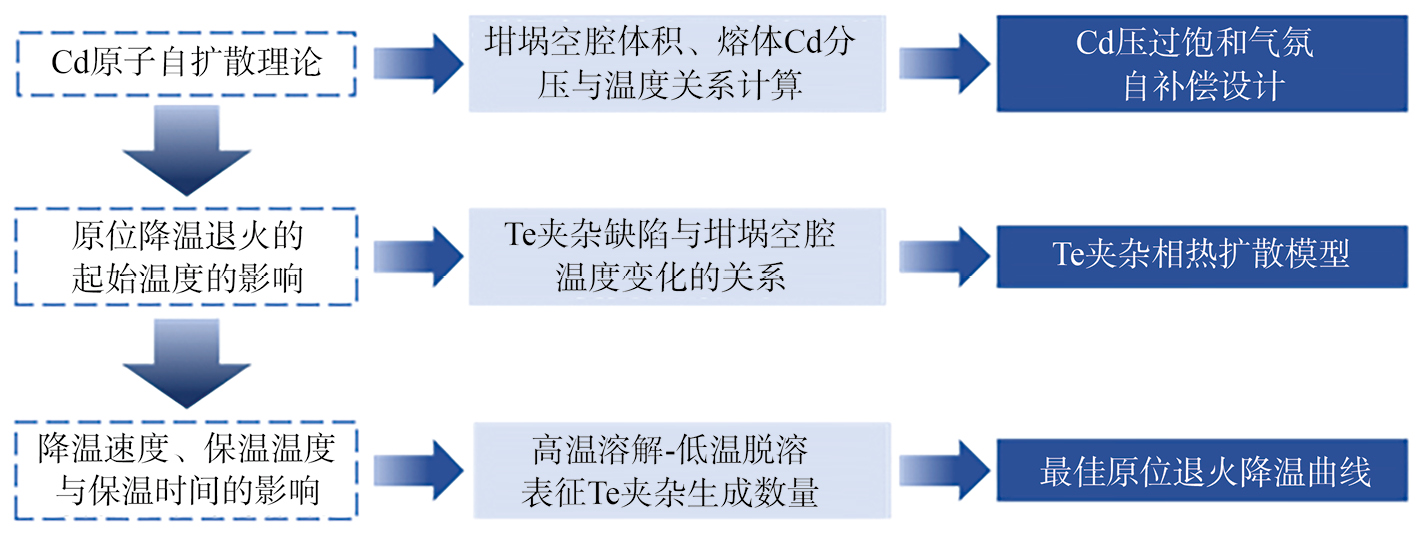
原位降温退火是抑制和消除晶体生长过程中缺陷的常用技术手段(图7)。2015年,Liang等[ Liang X Y,Min J H,Yang S,et al. Cooling process optimization to control Te inclusions for improving CdZnTe detector performance [J]. Materials Science in Semiconductor Processing,2015,30:14-17. 58]对CZT的降温速率与缺陷之间的关系进行了研究。研究表明,当降温速率为10~20 K/h时,虽然Te夹杂的数量有所减少,但夹杂的尺寸却增大了,这使得Te夹杂所占的体积分数增加,进而导致红外透过率降低。相反,当采用快速降温时,Te夹杂的尺寸减小,但数量却显著增加,且降温速率越快,Te夹杂的数量越多。2021年,Yuan等[ Yuan S Z,Zhao W,Kong J C,et al. Effect of in-situ post-annealing on the second-phase particles in HgCdTe films [J]. Infrared Technology,2021,43(11):1071-1077. 59]在研究退火温度对相夹杂缺陷密度和尺寸的影响时,以原位降温退火有效抑制了相夹杂缺陷的产生。目前的研究尚未形成系统且深入的理论体系,退火工艺对CZT晶体缺陷的抑制作用仍需进一步探索和优化。
图7 基于原位降温退火的缺陷消除技术路线
Fig. 7 In-situ controlled-cooling annealing strategy for defect annihilation
5.3 基于气氛掺杂退火的缺陷后补偿技术研究
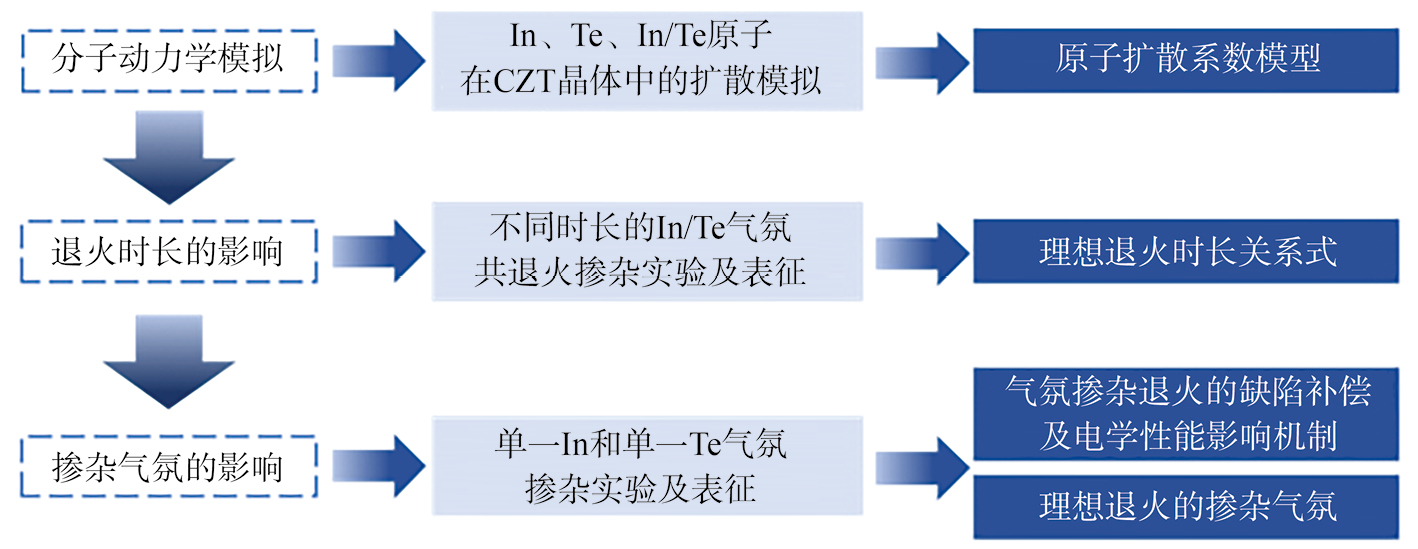
气氛掺杂退火工艺是一种消除晶体在生长后所产生缺陷的广泛而实用的技术,学者们对其应用于CZT晶体生长后的缺陷补偿也有所研究(见图8)。2014年,盛锋锋等[ Sheng F F,Yang J R,Sun S W,et al. Influence of Cd-rich annealing on defects in Te-rich CdZnTe materials [J]. Journal of Electronic Materials,2014,43(7):2702-2708. 60]探讨了富Te夹杂的CZT晶体在Cd气氛下退火对其缺陷的影响,以及CZT晶体中富Cd和富Te沉淀物对HgCdTe液相外延表面缺陷的作用机制。研究结果表明,富Cd气氛退火可以显著降低富Te夹杂的尺寸,然而在富Te夹杂物周围区域,出现了位错增殖和应力集中的现象,位错团簇产生的应力场影响范围甚至可以达到富Te夹杂物尺寸的5~8倍。同年,He等[ He Y H,Jie W Q,Wang T,et al. Migration of Te inclusions in CdZnTe single crystals under the temperature gradient annealing [J]. Journal of Crystal Growth,2014,402:15-21. 61]研究发现,在Cd/Zn源条件下,梯度温场退火对CZT材料中Te夹杂迁移有所影响。尤其是尺寸效应和空洞效应,对Te夹杂的消除效率和迁移性能的影响显著:尺寸效应会延长退火时间,而空洞效应会导致长时间退火后,尺寸为5~25 μm的Te夹杂或空洞密度增加。2015年,Piacentini等[ Piacentini G,Zambelli N,Benassi G,et al. Two-step thermal process in tellurium vapor for tellurium inclusion annealing in high resistivity CdZnTe crystals [J]. Journal of Crystal Growth,2015,415:15-19. 62]探索了两步气氛掺杂退火对高电阻率CZT晶体中Te夹杂的影响。研究指出,在700 ℃以上,无论是在Cd气氛还是Te气氛下退火,大尺寸的Te夹杂会减少,但小尺寸的Te夹杂(1~3 μm)数量会增加。此外,Te气氛退火能够保持材料的高阻特性。2023年,雷宇等[ 雷宇. 碲锌镉晶体缺陷抑制及电学性能研究 [D]. 湘潭:湘潭大学,2023. 63]通过分子动力学(MD)模拟建立In-CZT退火模型,得到In原子在不同退火温度下的扩散系数,并通过In/Te掺杂退火实验,成功将CZT晶体内的富Te夹杂去除。2025年,范叶霞等[ 范叶霞,刘江高,曹聪,等. 碲锌镉晶锭退火实验研究 [J]. 激光与红外,2025,55(9):1427-1433. 64]通过高温-真空退火工艺,成功去除大尺寸(>5 μm)第二相夹杂,并将Zn组分均匀性提升至0.001~0.002,红外透过率提升至65%以上。
图8 基于气氛掺杂退火的缺陷后补偿技术路线
Fig. 8 Defect post-compensation strategy based on ambient-atmosphere doping annealing
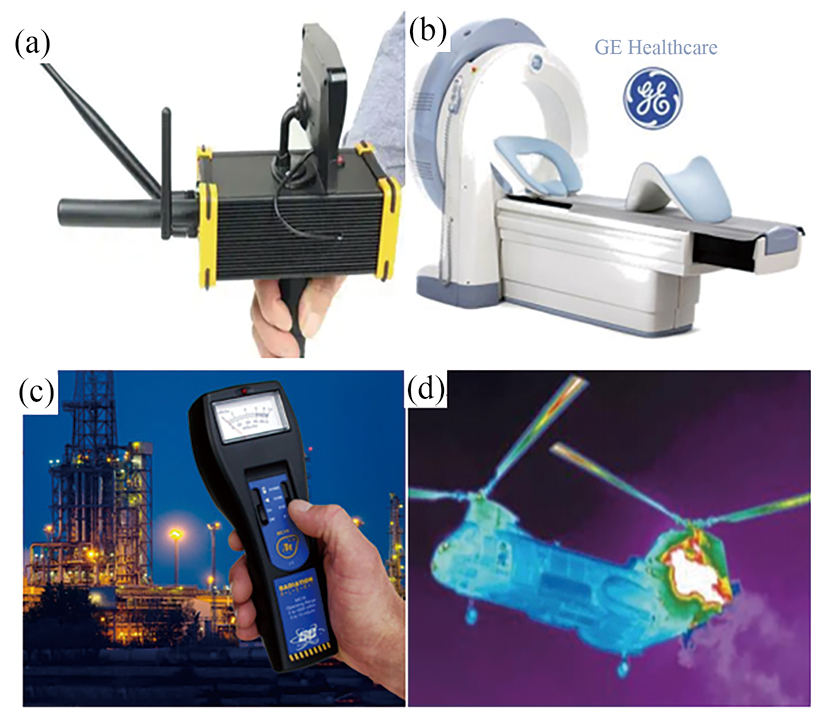
如图9所示,CZT探测器凭借低噪声、高能量与位置分辨率以及低剂量成像等特性,在资源勘探、医学影像、无损检测、国土安全等多个领域展现出卓越的应用前景[ 李尚书,徐超. 基于移动加热器法的碲锌镉晶体研究进展 [J]. 红外,2024,45(11):1-12. 31, Funaki M,Ozaki T,Satoh K,et al. Growth and characterization of CdTe single crystals for radiation detectors [J]. Nuclear Instruments and Methods in Physics Research Section A:Accelerators,Spectrometers,Detectors and Associated Equipment,1999,436(1/2):120-126. 46, Iniewski K. CdTe and CdZnTe materials:material properties and applications [M]. Cham:Springer Nature Switzerland,2024. 65]。
图9 CZT X射线探测器的应用:(a)资源勘探;(b)医学影像;(c)无损检测;(d)国土安全
Fig. 9 Applications of CZT X-ray detectors:(a) Resource exploration;(b) Medical imaging;(c) Non-destructive testing;(d) Territorial security
LiX Q,LiuA X,ChenJ H,et al. Design and technical research of intelligent maintenance support system of engineering equipment [C]//Proceedings of the 1st International Conference on Maintenance Engineering. Chengdu,China,2006:156-160.
[3]
RobbenC,de KorteJ,WotrubaH,et al. Experiences in dry coarse coal separation using X-ray-transmission-based sorting [J]. International Journal of Coal Preparation and Utilization,2014,34(3/4):210-219.
AhmedS N. Physics and engineering of radiation detection [M]. Amsterdam:Academic Press,2007.
[6]
AhmadM I,Ab RahimM H,NordinR,et al. Ionizing radiation monitoring technology at the verge of Internet of Things [J]. Sensors,2021,21(22):7629.
[7]
ToldráF. Irradiation of food commodities:techniques,applications,detection,legislation,safety and consumer opinion [J]. Trends in Food Science & Technology,2011,22(1):50.
EnlowE,AbbaszadehS. State-of-the-art challenges and emerging technologies in radiation detection for nuclear medicine imaging:a review [J]. Frontiers in Physics,2023,11:1106546.
DamuliraE. Radiation dosimetry in medicine using Ⅱ-Ⅵ semiconductors [J]. Journal of Radiation Research and Applied Sciences,2022,15(3):72-82.
[16]
XuY L,LinQ Q. Photodetectors based on solution-processable semiconductors:recent advances and perspectives [J]. Applied Physics Reviews,2020,7:011315.
[17]
AntonisP D. The first steps in solid-state X-ray imaging:the structure and electronic properties of cadmium zinc telluride radiation detectors [J]. Journal of Materials Science:Materials in Electronics,1998,9(4-5):331-340.
[18]
HubertC M,CookW R. Hard X-ray imaging detectors onboard the balloon-borne high-energy focusing telescope [A]//Semiconductor Radiation Detection Systems [M]. Boca Raton,FL:CRC Press,2010:137–140.
[19]
ZhanZ Y,ZhengL X,PanY Z,et al. Self-powered,visible-light photodetector based on thermally reduced graphene oxide–ZnO (rGO–ZnO) hybrid nanostructure [J]. J Mater Chem,2012,22(6):2589-2595.
[20]
KharatzadehA,Jamali-SheiniF,YousefiR. Excellent photocatalytic performance of Zn(1–x)MgxO/rGO nanocomposites under natural sunlight irradiation and their photovoltaic and UV detector applications [J]. Materials & Design,2016,107:47-55.
[21]
KoppensF H L,MuellerT,AvourisP,et al. Photodetectors based on graphene,other two-dimensional materials and hybrid systems [J]. Nature Nanotechnology,2014,9(10):780-793.
XuC,ZhangJ,ZhouC H,et al. Advancements in Iso-Diameter seeded growth of CdZnTe crystals:a numerical modeling approach and applications in liquid phase epitaxy [J]. Journal of Crystal Growth,2024,633:127670.
[24]
NeubertM,JurischM. Transient segregation behavior in Cd1–xZnxTe with low Zn content—a qualitative and quantitative analysis [J]. Journal of Crystal Growth,2015,420:101-108.
[25]
McCoyJ J,KakkireniS,GilveyZ H,et al. Overcoming mobility lifetime product limitations in vertical bridgman production of cadmium zinc telluride detectors [J]. Journal of Electronic Materials,2019,48(7):4226-4234.
[26]
SenS,StannardJ E. Developments in the bulk growth of Cd1−xZnxTe for substrates [J]. Progress in Crystal Growth and Characterization of Materials,1994,29(1/2/3/4):253-273.
[27]
LiG Q,ZhangX L,HuaH,et al. A modified vertical Bridgman method for growth of high-quality Cd1−xZnxTe crystals [J]. Journal of Electronic Materials,2005,34(9):1215-1224.
[28]
El MokriA,TribouletR,LussonA,et al. Growth of large,high purity,low cost,uniform CdZnTe crystals by the “cold travelling heater method” [J]. Journal of Crystal Growth,1994,138(1/2/3/4):168-174.
[29]
ZhouB R,JieW Q,WangT,et al. Modification of growth interface of CdZnTe crystals in THM process by ACRT [J]. Journal of Crystal Growth,2018,483:281-284.
SellH E,MüllerG. Numerical modelling of the growth and composition of Gax In1-x as bulk mixed crystals by the travelling heater method [J]. Journal of Crystal Growth,1989,97(1):194-200.
[36]
PetersonJ H,FiederleM,DerbyJ J. Analysis of the traveling heater method for the growth of cadmium telluride [J]. Journal of Crystal Growth,2016,454:45-58.
[37]
ZhangJ J,QiY W,LiuW P,et al. The effect of Te solution volume on the growth of CdZnTe crystals by traveling heater method [J]. Journal of Crystal Growth,2024,633:127647.
[38]
ZhangJ J,LiuW P,WeiJ J,et al. Investigation of the diffusion and crystal growth of CdZnTe in Te solution using the traveling heater method under axial static magnetic field [J]. CrystEngComm,2025,27(5):644-652.
[39]
ChenH,AwadallaS A,IniewskiK,et al. Characterization of large cadmium zinc telluride crystals grown by traveling heater method [J]. Journal of Applied Physics,2008,103:014903.
[40]
RoyU N,WeilerS,SteinJ,et al. Zinc mapping in THM grown detector grade CZT [J]. Journal of Crystal Growth,2012,347(1):53-55.
[41]
ChenH,AwadallaS A,MacKenzieJ,et al. Characterization of traveling heater method (THM) grown Cd0.9Zn0.1Te [J]. IEEE Transactions on Nuclear Science,2007,54(4):811-816.
SzelesC,CameronS E,SoldnerS A,et al. Development of the high-pressure electro-dynamic gradient crystal-growth technology for semi-insulating CdZnTe growth for radiation detector applications [J]. Journal of Electronic Materials,2004,33(6):742-751.
[44]
WangT,JieW Q,XuY D,et al. Characterization of CdZnTe crystal grown by bottom-seeded Bridgman and Bridgman accelerated crucible rotation techniques [J]. Transactions of Nonferrous Metals Society of China,2009,19:s622-s625.
[45]
OhmoriM,IwaseY,OhnoR. High quality CdTe and its application to radiation detectors [J]. Materials Science and Engineering:B,1993,16(1/2/3):283-290.
[46]
FunakiM,OzakiT,SatohK,et al. Growth and characterization of CdTe single crystals for radiation detectors [J]. Nuclear Instruments and Methods in Physics Research Section A:Accelerators,Spectrometers,Detectors and Associated Equipment,1999,436(1/2):120-126.
[47]
LiG Q,JieW Q,GuZ,et al. Correlation between the x value and qualities of Cd1−x Znx Te crystal grown by vertical Bridgman method [J]. Materials Science and Engineering:B,2004,107(2):172-175.
MühlbergM,RudolphP,GenzelC,et al. Crystalline and chemical quality of CdTe and Cd1-x Znx Te grown by the Bridgman method in low temperature gradients [J]. Journal of Crystal Growth,1990,101(1/2/3/4):275-280.
[50]
TribouletR. Crystal growth by traveling heater method[M]//Handbook of crystal growth. Amsterdam:Elsevier,2015:459-504.
[51]
PetersonJ H,CosenzaZ,DerbyJ J. Stability-based optimization of ACRT for the growth of CZT by the traveling heater method [J]. Journal of Crystal Growth,2022,579:126446.
[52]
ZhouB R,JieW Q,WangT,et al. Growth and characterization of detector-grade Cd0.9Zn0.1Te crystals by the traveling heater method with the accelerated crucible rotation technique [J]. Journal of Electronic Materials,2018,47(2):1125-1130.
[53]
VergerL,BaffertN,RosazM,et al. Characterization of CdZnTe and CdTe:Cl materials and their relationship to X-and γ-ray detector performance [J]. Nuclear Instruments and Methods in Physics Research Section A:Accelerators,Spectrometers,Detectors and Associated Equipment,1996,380(1/2):121-126.
[54]
ThioT,BennettJ W,ChadiD J,et al. DX centres in CdZnTe:Cl and their applications [J]. Journal of Crystal Growth,1996,159(1/2/3/4):345-349.
[55]
ZerraiA,DammakM,MarrakchiG,et al. Investigation of deep levels in vanadium-doped CdTe and CdZnTe [J]. Journal of Crystal Growth,1999,197(3):729-732.
[56]
PanchukO,SavitskiyA,FochukP,et al. Ⅳ group dopant compensation effect in CdTe [J]. Journal of Crystal Growth,1999,197(3):607-611.
[57]
LiL X,LuF Y,LeeC,et al. Studies of Cd-vacancies,indium dopant and impurities in CdZnTe crystals (Zn=10%)[C]//2003 IEEE Nuclear Science Symposium. Conference Record. Portland,OR,USA: IEEE,2003:3336-3337.
[58]
LiangX Y,MinJ H,YangS,et al. Cooling process optimization to control Te inclusions for improving CdZnTe detector performance [J]. Materials Science in Semiconductor Processing,2015,30:14-17.
[59]
YuanS Z,ZhaoW,KongJ C,et al. Effect of in-situ post-annealing on the second-phase particles in HgCdTe films [J]. Infrared Technology,2021,43(11):1071-1077.
[60]
ShengF F,YangJ R,SunS W,et al. Influence of Cd-rich annealing on defects in Te-rich CdZnTe materials [J]. Journal of Electronic Materials,2014,43(7):2702-2708.
[61]
HeY H,JieW Q,WangT,et al. Migration of Te inclusions in CdZnTe single crystals under the temperature gradient annealing [J]. Journal of Crystal Growth,2014,402:15-21.
[62]
PiacentiniG,ZambelliN,BenassiG,et al. Two-step thermal process in tellurium vapor for tellurium inclusion annealing in high resistivity CdZnTe crystals [J]. Journal of Crystal Growth,2015,415:15-19.