Effects of Cold Rolling Reduction Rate Distribution on Microstructure and Properties of Oxygen-Free Copper Strip
Citations
Hu Tongsheng,Qin Jing,Fu Tingting,Zhou Chen. Effects of cold rolling reduction rate distribution on microstructure and properties of oxygen-free copper strip[J]. Copper Engineering,2026(4):118-125.
1.Tongling Jinvi Copper Corporation,Tongling Nonferrous Metals Group Co.,Ltd.,Tongling244000,China
2.School of Materials Science and Engineering,Tongling University,Tongling244000,China
3.Anhui Joint Key Laboratory of Critical Technologies for High-End Copper-Based New Materials,Tongling244000,China
Citations
Hu Tongsheng,Qin Jing,Fu Tingting,Zhou Chen. Effects of cold rolling reduction rate distribution on microstructure and properties of oxygen-free copper strip[J]. Copper Engineering,2026(4):118-125.
Abstract
As core conductor materials for high-end electronic components and power transmission systems, oxygen-free copper strips require increasingly stringent performance specifications to meet diverse application demands. During cold rolling, different reduction rate distribution significantly influences material properties through microstructure transformation including grain orientation, dislocation density, and texture evolution. Under identical total deformation conditions, this study investigated effects of different cold rolling reduction rate distribution schemes on microstructure, texture, and performance of the material. Results showed that reducing the number of rolling can reduce the number of intermediate annealing and increase reduction rate of each rolling, which enhanced energy storage and nucleation sites formation to elevate recrystallization nucleation rates, ultimately leading to smaller final grain sizes. Increasing single reduction rates improved the proportion of various deformation textures, enhancing product microstructural uniformity. When single reduction rate exceeded 80%, orientation density of {112}<111>(copper), {110}<112>(brass), and {123}<634>(S) deformation textures was significantly enhanced, promoting the formation of strong {001}<100>(cube) textures during recrystallization annealing. Higher cube texture proportions contributed to lower microhardness and slightly improved conductivity of oxygen-free copper strips. The results provided a theoretical basis for adjustment of production process and optimization of product properties of oxygen-free copper strip.
随着新能源汽车、航空航天、高速铁路等高端装备制造领域的快速发展,以及引线框架、家用电器等电子电气行业的技术迭代,市场对铜板带的综合性能提出了更高要求。铜板带不仅需兼具高强度、优异的导电导热性,还要具备优良的冲压、弯曲、拉伸等成型性能[ Zhang X H,Zhang Y,Tian B H,et al. Review of nano-phase effects in high strength and conductivity copper alloys[J]. Nanotechnology Reviews,2019,8(1):383-395. Geng Y F,Ban Y J,Wang B J,et al. A review of microstructure and texture evolution with nanoscale precipitates for copper alloys[J]. Journal of Materials Research and Technology,2020,9(5):11918-11934. 1-2]。铜板带成型性主要取决于显微组织和晶体织构。例如,强立方织构{001}<100>会显著劣化无氧铜板带的深冲性能,原因是其0°、45°方向的r值差异显著,而{123}<634>(S)、{112}<111>(铜型)和{110}<112>(黄铜)等形变织构组分的协同共存,可有效提升材料的平均r值,优化成型效果[ Qin J,Zhou C,Wang D S,et al. Effects of microstructure and texture on the deep drawability of C10200 copper sheets[J]. Journal of Materials Research and Technology,2023,25:773-785. 3]。提高无氧铜管中高斯织构占比,可提高组织均匀性和弯折加工性能[ 曾何生,谭憧,马秀云,等. 退火工艺对热管用无氧铜管组织和性能的影响[J]. 铜业工程,2025(4):35-42. 4]。{001}<uv0>取向具有良好的折弯性能和较差的拉深性能,而{111}<uvw>取向具有较差的折弯性能和良好的拉深性能[ Inoue H. Simultaneous prediction of bendability and deep drawability based on orientation distribution function for polycrystalline cubic metal sheets[J]. Materials Science Forum,2018,941:1468-1473. 5]。因此,针对不同应用场景的服役需求,精准调控无氧铜带的织构类型与组分占比,开发定制化产品,是适应高端领域发展、提升铜加工产品竞争力的关键方向,具有重要的工程应用价值。
铜及铜合金的织构演变受化学成分、晶粒尺寸、第二相析出、变形量、变形方式及退火温度等因素的影响[ Li X,Zhou Y J,Liu Y H,et al. Texture evolution and its influence mechanism on properties of single crystal copper and polycrystalline copper during cumulative deformation[J]. Journal of Materials Research and Technology,2023,24:6808-6819. Hua Y X,Liu H T,Song K X,et al. Effect of cerium on microstructure,texture and properties of ultrahigh-purity copper[J]. Journal of Rare Earths,2024,42(1):220-227. Gong L K,Huang Y Q,Han Z,et al. Texture evolution and strengthening mechanism of CuCrZr alloys during cold rolling[J]. Vacuum,2024,221:112908. 6-8]。在纯铜中,铜型织构组分在轧制后会变得更强,而在层错能(SFE)较低的黄铜中,黄铜织构的形成会因孪晶旋转而得到促进[ Yang J Z,Bu K,Song K X,et al. Influence of low-temperature annealing temperature on the evolution of the microstructure and mechanical properties of Cu-Cr-Ti-Si alloy strips[J]. Materials Science and Engineering:A,2020,798:140120. 9]。合金元素的加入会改变SFE并促进第二相析出,从而影响织构的形成和发展。初始晶粒尺寸也会影响形变织构的类型。例如,轧制压下率达97%时,粗晶粒(24 μm)的样品呈现典型的铜型织构,而超细晶粒(0.36 μm)的样品则呈现黄铜织构[ Gu C F,Hoffman M,Toth L S,et al. Grain size dependent texture evolution in severely rolled pure copper[J]. Materials Characterization,2015,101:180-188. 10]。在沉淀强化铜合金中,织构演变与第二相粒子的尺寸、分布和体积分数相关[ 汪志刚,冯兴宇,杨泰胜,等. 第二相粒子与织构对高强Cu-Ni-Si系合金薄板各向异性的影响[J]. 工程科学学报,2017,39(6):867-874. Geng Y F,Zhang Y,Song K X,et al. Effect of Ce addition on microstructure evolution and precipitation in Cu-Co-Si-Ti alloy during hot deformation[J]. Journal of Alloys and Compounds,2020,842:155666. 11-12]。随着时效温度的升高,Cu-Ni-Si合金中第二相析出,铜型和高斯织构组分会逐渐减少,而立方织构组分会逐渐增加[ Liu Z S,Chen Y L,Wei H,et al. Study on the distribution of texture and the second phase under different aging process of Cu-Ni-Si alloy[J]. Materials Letters,2019,236:292-294. 13]。变形方式也是影响织构类型和分布的关键因素。面心立方(FCC)金属的变形机制主要是位错滑移,在变形过程中,铜型和黄铜织构相对稳定。随着孪晶的增加,铜型织构逐渐减弱,而黄铜织构会增强(剪切变形对黄铜织构有增强效应)。轧制压下率也是控制变形显微组织的关键工艺参数,多数变形织构会随着变形程度的增加而增强。对于Cu-Ni-Si合金,随着冷轧压下率的增加,铜型织构会逐渐向黄铜织构转变[ Wei H,Chen Y L,Su L,et al. Study on texture evolution and deformation mechanism of the Cu-Ni-Si alloy during cold-rolling treatment[J].Procedia Engineering,2017,207:1111–1116. 14]。不同轧制方式也会影响形变织构,如不对称轧制会导致晶粒取向围绕样品横向(TD)旋转[ Uniwersał A,Wroński M,Wróbel M,et al.Texture effects due to asymmetric rolling of polycrystalline copper[J]. Acta Materialia,2017,139:30-38. 15]。变形后的热处理会削弱变形织构并导致再结晶织构的形成。对晶粒取向影响最大的是晶界迁移,晶粒取向的差异和分布决定了再结晶织构的形成和发展[ Kikuchi S,Kimura E,Koiwa M. Deformation and recrystallization textures of copper single crystals and bicrystals[J]. Journal of Materials Science Letters,1992,27(18):4927-4934. 16]。S形变织构常受面心立方金属中的立方再结晶织构影响,与后者存在约40°的<111>取向差关系。还有研究表明,随着立方织构的出现,铜型织构会迅速消失,而S织构会缓慢减少,铜型织构对立方再结晶织构的影响大于S织构[ Hong S H,Lee D N. The evolution of the cube recrystallization texture in cold rolled copper sheets[J]. Materials Science and Engineering:A,2003,351(1/2):133-147. 17]。
Fig. 3 Distribution of recrystallization,substructure,and deformed structure in different finished samples:(a) Sample 1;(b) Sample 2;(c) Sample 3;(d) Sample 4
表2 试样成品中再结晶、亚结构和形变组织占比
Table 2 Proportions of recrystallization,substructure,and deformed structure in finished samples (%)
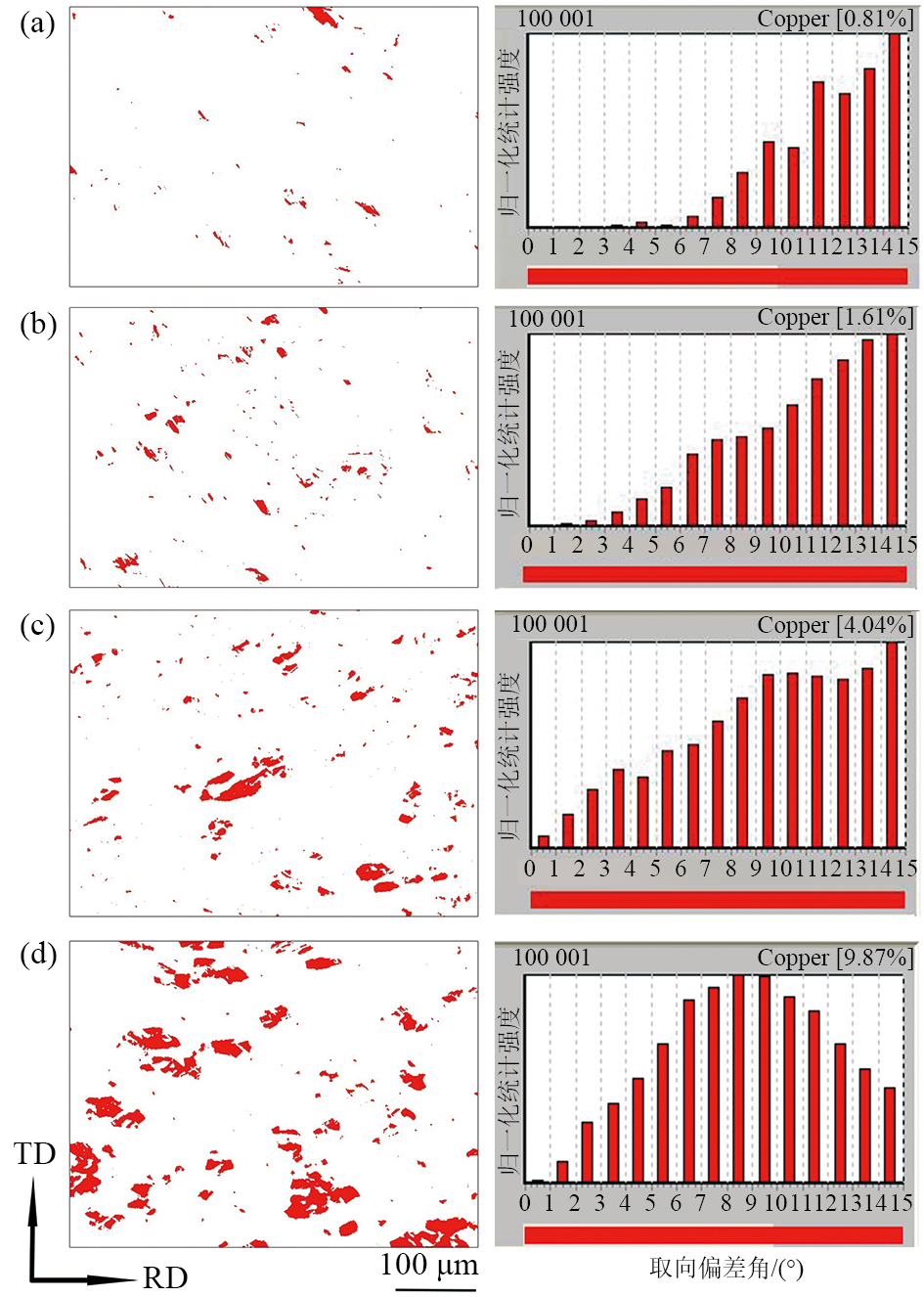
图5为成品试样中立方织构组分图及取向差分布图。可见试样1和试样2中立方取向的晶粒占比很小,分别为0.81%和1.61%,试样3中立方取向晶粒占比(4.04%)相较前两个试样则有明显增加,试样4中立方取向晶粒最多,为9.87%。根据立方晶粒取向差分布图(图5中取向差≤15°部分)可知,取向差越小,则取向一致性越高。对比分析可知,试样4的立方取向一致性最高。结合轧制工艺分析可知,试样3和试样4的轧程数量最少。研究表明,单次冷轧压下率越大,越容易形成强立方再结晶织构[ Qin J,Li X,Wang D S,et al. Microstructure and texture evolution in cold-rolled and annealed oxygen-free copper sheets[J]. Materials,2024,17(10):2202. 18]。相比试样3,试样4的前两次冷轧压下率均超过了80%,所以立方取向晶粒最多。
Fig. 5 Cube texture components and misorientation distributions in finished samples:(a) Sample 1;(b) Sample 2;(c) Sample 3;(d) Sample 4
成品试样中S、铜型、黄铜、高斯和立方织构组分的占比见表3。4种试样中铜型织构组分最多,S织构组分次之,高斯和黄铜织构组分最少。相对试样1和试样2,试样3和试样4中铜型织构组分占比明显增加,立方再结晶织构组分也逐渐增多。这是因为在总压下率一定的情况下,随着轧程数量减少,单次冷轧压下率增加,S、铜型和黄铜等形变织构不断增强。试样4相比试样3,立方织构组分明显增多,伴随着S和铜型织构的减少。这是由于存在特殊取向关系,立方取向晶粒在S和铜型取向形变基体中长大时具有较快的晶界迁移率,前期形成的强铜型和S织构为强立方再结晶织构的形成提供了有利条件[ Qin J,Li X,Wang D S,et al. Microstructure and texture evolution in cold-rolled and annealed oxygen-free copper sheets[J]. Materials,2024,17(10):2202. 18]。
表3 成品试样中S、铜型、黄铜、高斯和立方织构组分的占比
Table 3 Proportions of S,copper,brass,Goss and cube texture components in finished samples (%)
Fig. 6 (a) Microhardness and (b) conductivity of sample 1~4
无氧铜带导电率影响因素有纯度、杂质、轧制及热处理工艺等[ 李奥博. 均温板用高耐热稀土微合金化铜带材制备及机理研究[D]. 沈阳:沈阳理工大学,2024. 19]。冷轧过程中产生的晶格畸变及位错缺陷会阻碍电子定向流动,降低导电率,而晶界作为电子散射中心,其数量增加也会降低导电率。有研究表明,晶界数量的减少和强立方织构的形成有利于提高电导率[ Wang J J,Zhao Z Y,Jia Y L,et al. Influence of annealing texture evolution on the mechanical and electrical performance of rolled copper foils[J]. Materials Science and Engineering A,2025,927:147926. 20]。结合组织织构分析可知,试样晶粒尺寸略微减小对导电率影响较小,而立方再结晶织构的比重增大,形变织构组分减小,位错密度降低才是试样1~4的导电率逐渐提高的主要原因。
ZhangX H,ZhangY,TianB H,et al. Review of nano-phase effects in high strength and conductivity copper alloys[J]. Nanotechnology Reviews,2019,8(1):383-395.
[2]
GengY F,BanY J,WangB J,et al. A review of microstructure and texture evolution with nanoscale precipitates for copper alloys[J]. Journal of Materials Research and Technology,2020,9(5):11918-11934.
[3]
QinJ,ZhouC,WangD S,et al. Effects of microstructure and texture on the deep drawability of C10200 copper sheets[J]. Journal of Materials Research and Technology,2023,25:773-785.
InoueH. Simultaneous prediction of bendability and deep drawability based on orientation distribution function for polycrystalline cubic metal sheets[J]. Materials Science Forum,2018,941:1468-1473.
[6]
LiX,ZhouY J,LiuY H,et al. Texture evolution and its influence mechanism on properties of single crystal copper and polycrystalline copper during cumulative deformation[J]. Journal of Materials Research and Technology,2023,24:6808-6819.
[7]
HuaY X,LiuH T,SongK X,et al. Effect of cerium on microstructure,texture and properties of ultrahigh-purity copper[J]. Journal of Rare Earths,2024,42(1):220-227.
[8]
GongL K,HuangY Q,HanZ,et al. Texture evolution and strengthening mechanism of CuCrZr alloys during cold rolling[J]. Vacuum,2024,221:112908.
[9]
YangJ Z,BuK,SongK X,et al. Influence of low-temperature annealing temperature on the evolution of the microstructure and mechanical properties of Cu-Cr-Ti-Si alloy strips[J]. Materials Science and Engineering:A,2020,798:140120.
[10]
GuC F,HoffmanM,TothL S,et al. Grain size dependent texture evolution in severely rolled pure copper[J]. Materials Characterization,2015,101:180-188.
GengY F,ZhangY,SongK X,et al. Effect of Ce addition on microstructure evolution and precipitation in Cu-Co-Si-Ti alloy during hot deformation[J]. Journal of Alloys and Compounds,2020,842:155666.
[13]
LiuZ S,ChenY L,WeiH,et al. Study on the distribution of texture and the second phase under different aging process of Cu-Ni-Si alloy[J]. Materials Letters,2019,236:292-294.
[14]
WeiH,ChenY L,SuL,et al. Study on texture evolution and deformation mechanism of the Cu-Ni-Si alloy during cold-rolling treatment[J].Procedia Engineering,2017,207:1111–1116.
[15]
UniwersałA,WrońskiM,WróbelM,et al.Texture effects due to asymmetric rolling of polycrystalline copper[J]. Acta Materialia,2017,139:30-38.
[16]
KikuchiS,KimuraE,KoiwaM. Deformation and recrystallization textures of copper single crystals and bicrystals[J]. Journal of Materials Science Letters,1992,27(18):4927-4934.
[17]
HongS H,LeeD N. The evolution of the cube recrystallization texture in cold rolled copper sheets[J]. Materials Science and Engineering:A,2003,351(1/2):133-147.
[18]
QinJ,LiX,WangD S,et al. Microstructure and texture evolution in cold-rolled and annealed oxygen-free copper sheets[J]. Materials,2024,17(10):2202.
[19]
李奥博. 均温板用高耐热稀土微合金化铜带材制备及机理研究[D]. 沈阳:沈阳理工大学,2024.
[20]
WangJ J,ZhaoZ Y,JiaY L,et al. Influence of annealing texture evolution on the mechanical and electrical performance of rolled copper foils[J]. Materials Science and Engineering A,2025,927:147926.