Zuo Zongliang,Liu Xiaonan,Yan Fengshun,Zhang Qingjian,Jiao Lijing,Lü Wen,Li Peilin,Zhang Zhiyong. Research progress in waste heat recovery technologies for typical non-ferrous metallurgical slags[J]. Copper Engineering,2026(4):13-23.
Abstract
Non-ferrous metallurgical slags generated during pyrometallurgical smelting of non-ferrous metals cause environmental pollution as a stockpile, but slags also have enormous potentials for waste heat recovery and valuable metal recycling. This paper systematically synthesized common and specific physicochemical characteristics of non-ferrous metallurgical slags. It focused on research progress, core principles, process optimization directions, technical advantages, and application bottlenecks of waste heat recovery technologies for three typical slags (copper slag, ferronickel slag, and lead slag), which were classified into physical methods and chemical methods, and summarized research hotspots and development trends of each technology. Physical methods were centered on synergistic technology of granulation and heat exchange, while chemical methods focused on synergistic recovery of waste heat and resources. Cascaded recovery system integrating the two is the main development direction in the future. This paper provided theoretical reference and technical support for industrial upgrading and green development of waste heat recovery technologies for non-ferrous metallurgical slags.
Table 1 Main chemical components of copper slag produced by different copper smelting methods (%,mass fraction)[ 王琛,田庆华,王亲猛,等. 铜渣有价金属综合回收研究进展[J]. 金属材料与冶金工程,2014,42(6):50-56. 许并社,李明照. 铜冶炼工艺[M]. 北京:化学工业出版社,2007. 王华,李磊. 铜渣中有价金属回收的应用基础研究[M]. 北京:科学出版社,2013. 郭秀键,倪晓明,马丁,等. 铜渣处理与综合利用[J]. 有色冶金设计与研究,2017,38(2):23-26. Tian H Y,Guo Z Q,Pan J,et al. Comprehensive review on metallurgical recycling and cleaning of copper slag[J]. Resources,Conservation and Recycling,2021,168:105366. 8-12]
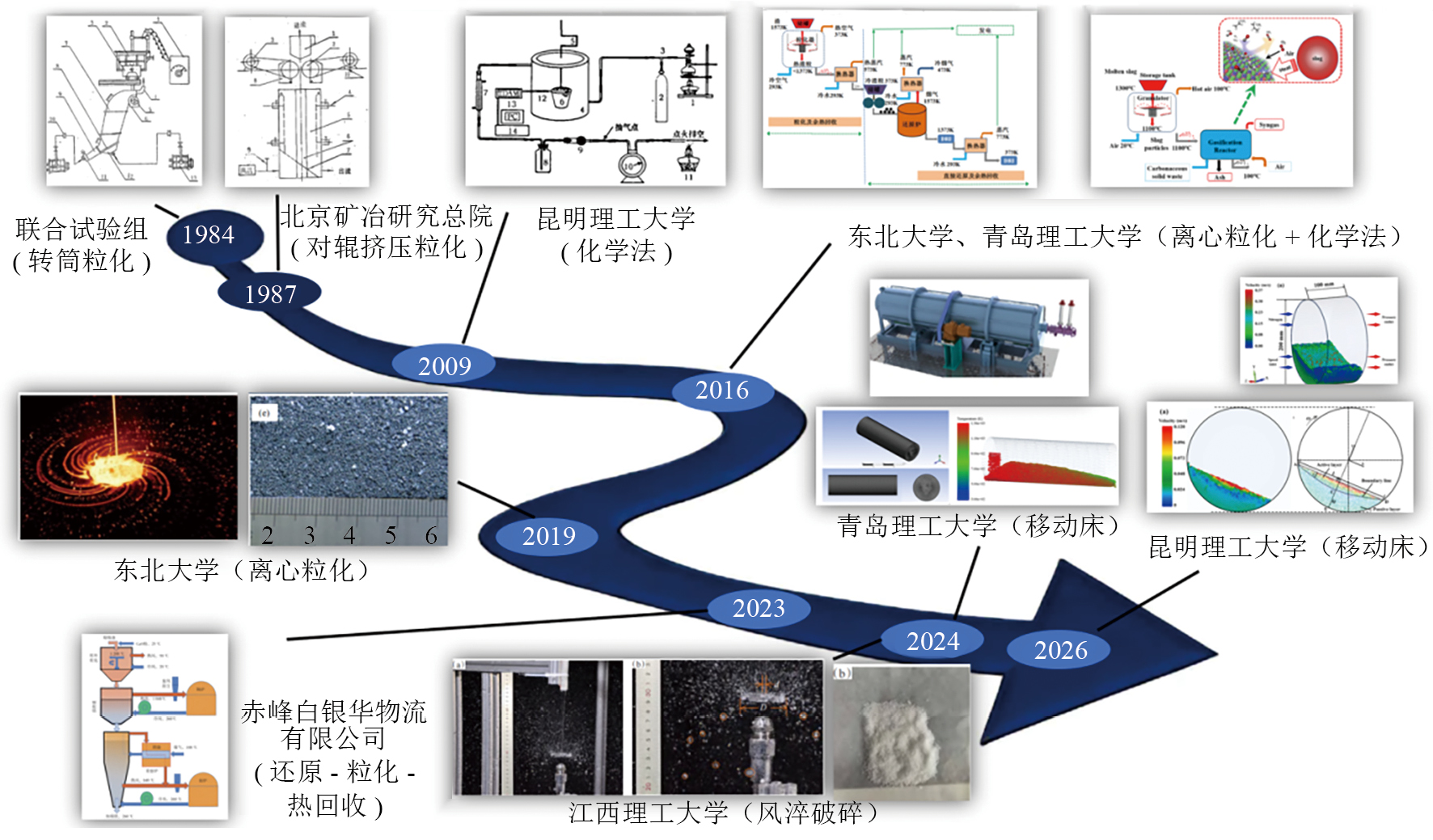
2016—2024年(多技术融合阶段)[ Zuo Z L,Feng Y,Dong X J,et al. Advances in recovery of valuable metals and waste heat from copper slag[J]. Fuel Processing Technology,2022,235:107361. 左宗良. 粒化铜渣余热回收及碳基直接还原的应用基础研究[D]. 沈阳:东北大学,2019. 2-3, Zuo Z L,Yu Q B,Xie H Q,et al. Thermodynamic analysis on molten slag waste heat cascade recovery method (MS-WHCR)[J]. Journal of Thermal Analysis and Calorimetry,2018,134(3):2171-2181. Zuo Z L,Feng Y,Dong X J,et al. Energy absorption characteristics and kinetics of carbonaceous solid waste gasification with copper slag as heat carrier[J]. International Journal of Hydrogen Energy,2022,47(46):20076-20086. Zuo Z L,Jing T,Wang J M,et al. Sludge gasification using iron bearing metallurgical slag as heat carrier:characteristics and kinetics[J]. Energies,2022,15(23):9223. Zuo Z L,Feng Y,Yang H Q,et al. Exploring the use of modified copper slag by copper concentrate in chemical chain gasification:oxygen absorption and release kinetics[J]. Energy,2025,332:137071. 21-24]:东北大学开发离心粒化技术,青岛理工大学、东北大学探索“离心粒化+化学法”的融合工艺,江西理工大学[ 戴鹏飞,张斌,黎显俊,等. 高温铜渣风淬造粒实验研究及铜渣液滴冷凝过程的数值模拟[J]. 有色金属科学与工程,2024,15(5):650-659. 25]开展风淬破碎研究,并逐步推进移动床换热等高效热回收单元的模拟与试验。
2024—2026年(技术深化拓展阶段):青岛理工大学、昆明理工大学[ Ma C W,Hu J H,Wang H,et al. CFD-DEM investigation of the flow and heat transfer characteristic of copper slag and biomass particles in a coupled waste heat utilization system[J]. Powder Technology,2026,469:121713. 26]完善移动床换热系统,赤峰白银物流有限公司[ 史彦辉,武海军,杨国强,等. 粒化—气基直接还原回收铜渣余热和有价金属[J]. 矿冶,2023,32(4):83-87. 27]提出“还原-粒化-热回收”工艺。
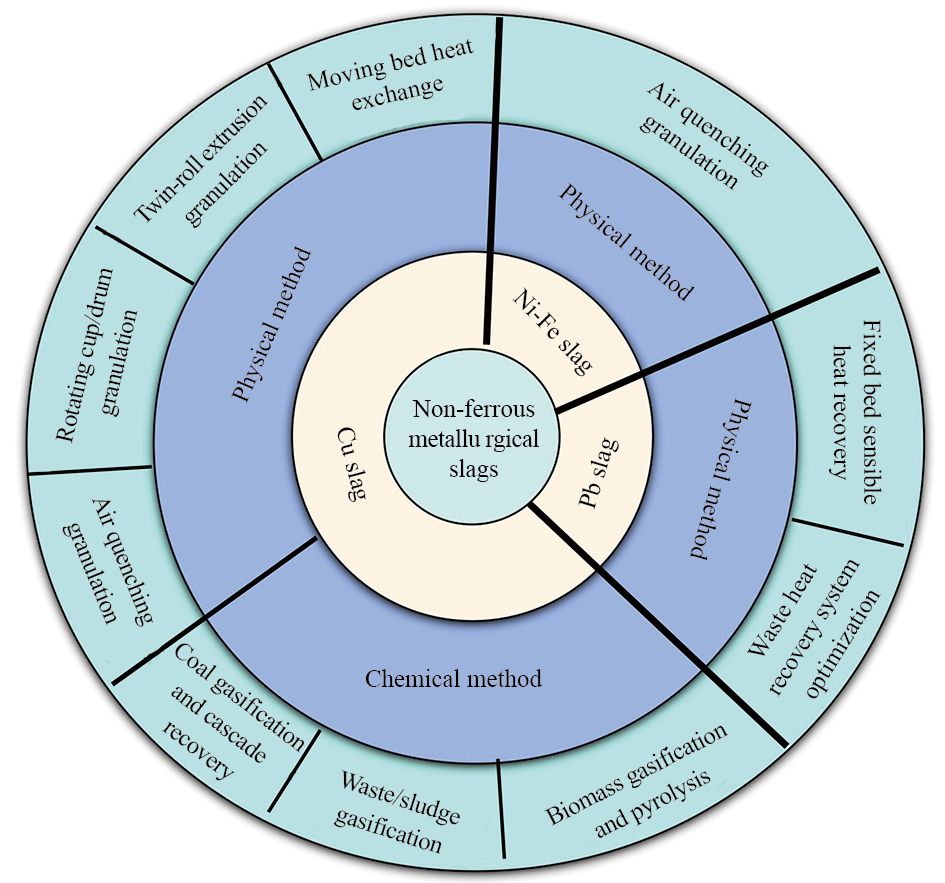
4)移动床换热技术。 昆明理工大学胡建航等[ Ma C W,Hu J H,Wang H,et al. CFD-DEM investigation of the flow and heat transfer characteristic of copper slag and biomass particles in a coupled waste heat utilization system[J]. Powder Technology,2026,469:121713. 26, Ma Y L,Cao W B,Zhang F X,et al. Numerical study on the waste heat recovery from multi-sized copper slag particles by the moving bed[J]. Energy Sources,Part A:Recovery,Utilization,and Environmental Effects,2025,47(1):5733-5754. 30]通过CFD-DEM模拟研究了铜渣不同粒度颗粒在移动床中的动态换热特性。阎新志等[ 阎新志,杨国强,武海军,等. 高温铜渣颗粒流换热CFD模拟研究[J]. 矿冶,2023,32(6):82-87. 31]采用CFD模拟研究颗粒塔换热时发现:260 ℃冷却空气穿过1.5~3 mm铜渣时,气流速度从4 m/s增至10 m/s,换热量线性提升至7.0×107 W,但压降从0.3 MPa升至2.1 MPa,需在换热效率与能耗之间平衡;颗粒塔的冷却前沿分界面随气流速度上移,为换热区高度设计提供了量化依据。
1)生物质气化与热解。 以生物质为还原剂或热解原料,利用铜渣余热驱动反应,同步回收Fe、Cu等有价金属与生物质能。Zuo等[ Zuo Z L,Yu Q B,Wei M Q,et al. Thermogravimetric study of the reduction of copper slag by biomass[J]. Journal of Thermal Analysis and Calorimetry,2016,126(2):481-491. 左宗良. 生物质热解及生物质还原铜渣的实验研究[D]. 沈阳:东北大学,2015. Zuo Z L,Yu Q B,Xie H Q,et al. Thermogravimetric analysis of the biomass pyrolysis with copper slag as heat carrier[J]. Journal of Thermal Analysis and Calorimetry,2017,129(2):1233-1241. 32-34]用热重分析表明,松木锯末还原铜渣效果最优,生物质/渣质量比为2∶1时还原率达80.6%,CaO添加比例为0.3∶1时可提升反应效率,反应符合收缩核模型。同时发现铜渣作为热载体可提升生物质热解气产量与H2产率,生物质/铜渣质量比为1∶1时热解气低位热值最高,铜渣可促进主反应与烃类裂解,但无法降低反应活化能。李娟琴等[ 李娟琴,胡建杭,王华,等. 高温铜渣催化木屑水蒸气气化的实验研究[J]. 过程工程学报,2012,12(5):876-881. 20, 李娟琴,胡建杭,王华,等. 利用高温铜渣余热进行生物质水蒸气汽化的热力学分析[J]. 材料导报,2013,27(4):154-158,162. 35]开展了铜渣催化木屑水蒸气气化实验。结果表明,1 000 ℃煅烧5 h的铜渣催化效果最优,906 ℃、铜渣/生物质质量比1.63时气化效率达92.85%,铜渣温度降低130~240 ℃,余热利用率为18.49%~22.63%。
2)垃圾/污泥气化。 “以废治废”,即利用铜渣余热驱动城市生活垃圾、污泥等有机废物气化[ Zuo Z L,Feng Y,Dong X J,et al. Energy absorption characteristics and kinetics of carbonaceous solid waste gasification with copper slag as heat carrier[J]. International Journal of Hydrogen Energy,2022,47(46):20076-20086. 22, Zuo Z L,Luo S Y,Liu S H,et al. Thermokinetics of mass-loss behavior on direct reduction of copper slag by waste plastic char[J]. Chemical Engineering Journal,2021,405:126671. 36]。赖坤等[ 赖坤,何屏,袁永功,等. 高温铜渣气化城市生活垃圾试验研究[J]. 资源开发与市场,2009,25(6):492-494. 18]以1 200~1 350 ℃铜渣为热载体,在水蒸气载气下实现生活垃圾气化,铜渣中MgO、CaO及Cu元素可催化焦油裂解,提升CO、H2等可燃组分含量。 900 ℃时反应速率最快,瞬时产气量峰值最高。Zuo等[ Zuo Z L,Jing T,Wang J M,et al. Sludge gasification using iron bearing metallurgical slag as heat carrier:characteristics and kinetics[J]. Energies,2022,15(23):9223. 23]对比铜渣与镍渣对污泥气化的催化效果发现:镍渣因CaO含量高,转化率优于铜渣(7.8%),提升了11.8%;煅烧改性可增强铜渣催化活性,转化率进一步提升14.5%。 据此提出了铜渣氧化处理、镍渣避免氧化的差异化方案。
3)煤气化与梯级回收。 通过煤气化吸热反应回收余热,同步制备高价值合成气。Zuo等[ Yang H Q,Dong X J,Zuo Z L,et al. The effect of CaO on coal gasification reaction with high-temperature copper slag as catalyst[J]. Energy Sources,Part A:Recovery,Utilization,and Environmental Effects,2023,45(3):9450-9464. Zuo Z L,Yu Q B,Liu S H,et al. Thermodynamic analysis of thermal energy recovery and direct reduction (TER-DR) system for molten copper slag[J]. Journal of Thermal Analysis and Calorimetry,2018,131(2):1691-1698. 37-38]提出热回收-直接还原(TER-DR)系统,引入CO2重整CH4反应(高㶲值吸热反应),使系统㶲效率从物理法的57.3%提升至61.3%,每吨铜渣可额外产出67.3 m3 CO和H2。在梯级回收方面,Zuo等[ Zuo Z L,Yu Q B,Xie H Q,et al. Thermodynamic analysis on molten slag waste heat cascade recovery method (MS-WHCR)[J]. Journal of Thermal Analysis and Calorimetry,2018,134(3):2171-2181. 21]设计了“高温气化/煅烧-中低温热解”梯级系统,㶲效率达66.6%~70.1%,显著优于传统水淬法(20.7%)与重力床物理法(52.2%)。 其中气化-热解(G-P)系统能效最高,强化热解系统可提升热解气H2含量至84.9%。此外,铜渣还可经羧基介导路径催化水煤气变换反应,Fe2O3活性组分可优化中间体吸附强度,实现余热回收与制氢的协同。 添加CaO可进一步提升煤气化H2比例,C∶S∶CaO=1∶1∶2时总失重率最高,形成的铁基多孔结构可强化传质过程[ Yang H Q,Dong X J,Zuo Z L,et al. The effect of CaO on coal gasification reaction with high-temperature copper slag as catalyst[J]. Energy Sources,Part A:Recovery,Utilization,and Environmental Effects,2023,45(3):9450-9464. 37]。
TianH Y,GuoZ Q,PanJ,et al. Comprehensive review on metallurgical recycling and cleaning of copper slag[J]. Resources,Conservation and Recycling,2021,168:105366.
[13]
张林楠. 铜渣中有价组分的选择性析出研究[D]. 沈阳:东北大学,2005.
[14]
GoraiB,JanaR K,Premchand. Characteristics and utilisation of copper slag—a review[J]. Resources,Conservation and Recycling,2003,39(4):299-313.
ZuoZ L,YuQ B,XieH Q,et al. Thermodynamic analysis on molten slag waste heat cascade recovery method (MS-WHCR)[J]. Journal of Thermal Analysis and Calorimetry,2018,134(3):2171-2181.
[22]
ZuoZ L,FengY,DongX J,et al. Energy absorption characteristics and kinetics of carbonaceous solid waste gasification with copper slag as heat carrier[J]. International Journal of Hydrogen Energy,2022,47(46):20076-20086.
[23]
ZuoZ L,JingT,WangJ M,et al. Sludge gasification using iron bearing metallurgical slag as heat carrier:characteristics and kinetics[J]. Energies,2022,15(23):9223.
[24]
ZuoZ L,FengY,YangH Q,et al. Exploring the use of modified copper slag by copper concentrate in chemical chain gasification:oxygen absorption and release kinetics[J]. Energy,2025,332:137071.
MaC W,HuJ H,WangH,et al. CFD-DEM investigation of the flow and heat transfer characteristic of copper slag and biomass particles in a coupled waste heat utilization system[J]. Powder Technology,2026,469:121713.
MaY L,CaoW B,ZhangF X,et al. Numerical study on the waste heat recovery from multi-sized copper slag particles by the moving bed[J]. Energy Sources,Part A:Recovery,Utilization,and Environmental Effects,2025,47(1):5733-5754.
ZuoZ L,YuQ B,WeiM Q,et al. Thermogravimetric study of the reduction of copper slag by biomass[J]. Journal of Thermal Analysis and Calorimetry,2016,126(2):481-491.
[33]
左宗良. 生物质热解及生物质还原铜渣的实验研究[D]. 沈阳:东北大学,2015.
[34]
ZuoZ L,YuQ B,XieH Q,et al. Thermogravimetric analysis of the biomass pyrolysis with copper slag as heat carrier[J]. Journal of Thermal Analysis and Calorimetry,2017,129(2):1233-1241.
ZuoZ L,LuoS Y,LiuS H,et al. Thermokinetics of mass-loss behavior on direct reduction of copper slag by waste plastic char[J]. Chemical Engineering Journal,2021,405:126671.
[37]
YangH Q,DongX J,ZuoZ L,et al. The effect of CaO on coal gasification reaction with high-temperature copper slag as catalyst[J]. Energy Sources,Part A:Recovery,Utilization,and Environmental Effects,2023,45(3):9450-9464.
[38]
ZuoZ L,YuQ B,LiuS H,et al. Thermodynamic analysis of thermal energy recovery and direct reduction (TER-DR) system for molten copper slag[J]. Journal of Thermal Analysis and Calorimetry,2018,131(2):1691-1698.