First-principle Study of Cr Doping on Cu/Al/Ag-diamond Interface
Citations
Ma Rui,Sun Jingjing,Li Wenna,Li Lin,Li Meng,Huang Hai. First-principle study of Cr doping on Cu/Al/Ag-diamond interface [J]. Copper Engineering,2026(3):86-94.
1.School of Physics and Optoelectronic Engineering,Zhongyuan University of Technology,Zhengzhou450007,China
2.Department of Physics,Zhengzhou University,Zhengzhou450001,China
Citations
Ma Rui,Sun Jingjing,Li Wenna,Li Lin,Li Meng,Huang Hai. First-principle study of Cr doping on Cu/Al/Ag-diamond interface [J]. Copper Engineering,2026(3):86-94.
Abstract
Metal/diamond composites with excellent thermal and mechanical properties are promising materials for thermal management applications, but the weak interfacial bonding between metals and diamond restricts industrialization processing. In this study, first-principle calculations based on density functional theory were employed, focusing on the (111) planes of three face-centered cubic (FCC) metals (Al, Cu, and Ag) and the (111) plane of diamond. A series of Cr-doped interface models with a concentration gradient of 12.5%~62.5% were constructed to systematically investigate the regulatory effect of Cr doping on interfacial bonding performance. Combined with calculations of surface relaxation, surface energy, and interfacial adhesion work, as well as analyses of charge density difference and partial density of states (PDOS), the microscopic mechanism of interfacial strengthening was revealed. Results showed that Cr doping exhibited a significant strengthening effect on Cu/diamond and Ag/diamond interfaces: adhesion work presented a distinct increasing trend with the rise of doping concentration, reaching 0.265 J/m2 and 0.254 J/m2, respectively, at a concentration of 62.5%, both significantly higher than those at 12.5% concentration. In contrast, due to the strong intrinsic Al-C polar covalent bonds and saturated electronic structure at the Al/diamond interface, Cr doping only slightly improved adhesion work to 0.293 J/m2, showing low sensitivity to concentration changes. Analysis of interfacial electronic structure confirmed that introduction of Cr can form stable Cr-C covalent bonds through strong hybridization between Cr-3d orbit and C-2p orbit, thereby reconstructing interfacial electronic structure. However, Al formed saturated covalent bonds with C, making it difficult for Cr to participate in effective hybridization. This study provided an important theoretical basis for optimization interfacial design of metal/diamond composite materials and offered guiding significance for promoting their applications in fields such as thermal management.
Keywords
interfacial strengthening;metal-diamond interface;chromium doping;charge density difference and density of states;doping concentration;first-principle;
金刚石(diamond)具有极高的热导率、优异的化学稳定性及绝缘特性,与高导电率的金属复合形成的金属/金刚石复合材料,在高功率电子器件封装、新能源汽车电机散热、航空航天领域的热管理系统等场景中展现出不可替代的应用潜力[ 陈冰威,韩金江,余威,等. 金刚石表面改性及基体合金化对金刚石/铜复合材料导热性能的影响 [J]. 粉末冶金技术,2022,40(3):258-266. 庞兴志,覃伟沛,李安敏,等. Nb元素对铜-金刚石复合材料界面改性的研究 [J]. 有色金属工程,2024,14(8):1-8. 王宛玉,王虎,郭慧稳,等. 微量Ag元素对Cu-Ag合金抗软化性能的影响及机理分析 [J]. 铜业工程, 2025(5): 42-51. 1-3]。然而,金刚石与高导电率金属之间润湿性差、界面结合强度弱,严重制约了其在热界面材料与复合结构中的可靠性和服役寿命。因此,如何有效增强金属/金刚石界面的结合强度,成为该领域的关键科学问题之一[ Cao Y X,Wu M,Fang Y,et al. The effects of alloying elements on the bonding strength of diamond/carbide/Cu interface based on first-principles calculations [J]. Physica Status Solidi (b), 2023, 260(9):2300059. Bai G Z,Wang L H,Zhang Y J,et al. Tailoring interface structure and enhancing thermal conductivity of Cu/diamond composites by alloying boron to the Cu matrix [J]. Materials Characterization,2019,152:265-275. Liu Z J,Zheng S X,Lu Z B,et al. Adhesive transfer at copper/diamond interface and adhesion reduction mechanism with fluorine passivation:a first-principles study [J]. Carbon,2018,127:548-556. 4-6]。
铝(Al)、铜(Cu)、银(Ag)是常用的金属基体材料,而其与金刚石之间的界面结合机制存在显著差异[ Zhu P,Zhang Q,Xia Y X,et al. Unveiling the interface characteristics of diamond/Al interface:First-principles calculations and experiments [J]. Applied Surface Science,2025,685:161969. 张永杰,董应虎,张瑞卿,等. 金刚石/铜复合材料导热性能的数值模拟 [J]. 材料热处理学报,2018,39(6):110-117. Jhong Y S,Hsieh M C,Lin S J. Effect of Ag/Cu matrix composition on thermal properties of diamond/Ag/Cu-Ti composites fabricated by pressureless sintering [J]. Materials Letters,2019,254:316-319. 7-9]。近年来,界面掺杂被认为是一种有效的界面强化策略,尤其是过渡金属元素的引入,有望通过形成强共价键增强界面结合。Liu等[ Liu X Y,Wang L H,Zhang Y J,et al. Microstructural evolution of sandwiched Cr interlayer in Cu/Cr/diamond subjected to heat treatment [J]. Thin Solid Films,2021,736:138911. 10]通过在Cu/diamond界面引入铬(Cr)夹层,研究其热处理后的微观结构演变,证实Cr过渡层能够有效改善界面结合状态。Han等[ Han J,Yang X,Ren Y,et al. Effects of alloying elements on diamond/Cu interface properties based on first-principles calculations [J]. Journal of Physics:Condensed Matter,2023,35(11):115001. 11]通过系统的第一性原理计算,详细揭示了多种合金元素对Cu/diamond界面结合特性的影响规律,建立了界面性能与电子结构之间的构效关系,为界面优化设计提供了重要的理论指导。Gu等[ Gu K X,Pang M J,Zhan Y Z. Insight into interfacial structure and bonding nature of diamond(001)/Cr3C2(001) interface [J]. Journal of Alloys and Compounds,2019,770:82-89. 12]同样采用第一性原理计算,揭示了Cr掺杂对增强Cu/diamond界面强度的影响,从微观层面揭示了Cr过渡层改善界面结合性能的机制。尽管近年来关于Cr元素掺杂对金属界面结合性能影响的研究取得了诸多重要成果,但现有研究多集中于单一基底或固定掺杂浓度下的界面行为分析,缺乏对不同金属基底类型(如Al、Cu、Ag)的系统对比。目前,关于第一性原理计算中过渡金属不同的掺杂浓度对界面结合性能影响的研究较少,在不同金属基底(如Al、Cu、Ag)中引入不同浓度梯度的Cr元素后,学术界对其界面区域的微观结构与力学性能的强化机制及其内在规律的认识仍存在明显不足,关于Cr掺杂浓度梯度变化对界面强化效应的影响机制仍需进一步深入探讨。
鉴于密度泛函理论(DFT)在揭示界面结构、界面改性等方面的优势,本研究采用基于DFT的第一性原理计算,通过Vienna Ab Initio Simulation Package (VASP)软件进行结构优化、界面性质及能量等计算。对于电子和离子之间的相互作用,本研究采用投影缀加平面波(projector-augmented plane wave,PAW)方法对其进行描述。交换关联函数选用广义梯度近似(generalized gradient approximation,GGA)下的Perdew-Burke-Ernzerhof (PBE)泛函形式[ Wu Z G,Cohen R E. More accurate generalized gradient approximation for solids [J]. Physical Review B,2005,73(23):235116. Xie H N,Chen Y T,Zhang T B,et al. Adhesion, bonding and mechanical properties of Mo doped diamond/Al(Cu) interfaces:a first principles study [J]. Applied Surface Science,2020,527:146817. Zhang H L,Qi Y X,Li J W,et al. Effect of Zr content on mechanical properties of diamond/Cu-Zr composites produced by gas pressure infiltration [J]. Journal of Materials Engineering and Performance,2018,27(2):714-720. 13-15]。平面波基组的截止能量设为450 eV,电子自洽循环迭代精度设置为1×10⁻⁵ eV,最大位移为1×10⁻⁴ nm,最大作用力为0.002 eV/nm。
2 结果与讨论
2.1 界面模型建立
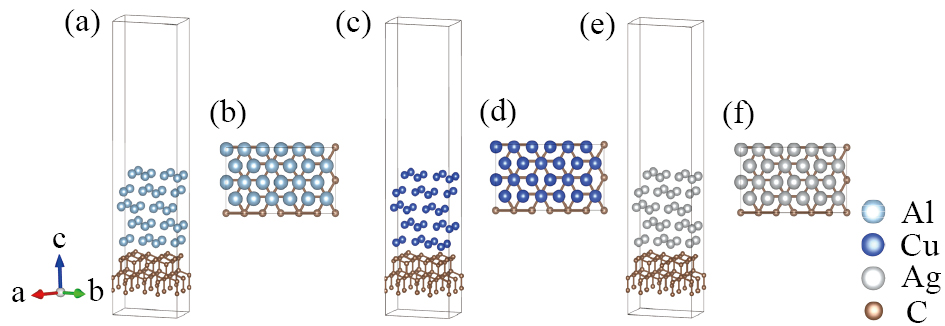
为了验证计算方法的有效性,对Al、Cu、Ag和diamond的体相性质进行了研究。将Al、Cu、Ag和diamond晶胞进行完全弛豫,使其达到稳定状态,获得能量最低构型的晶格常数,并且与其他计算和实验结果进行比较[ Keal T W,Tozer D J. A semiempirical generalized gradient approximation exchange-correlation functional [J]. Journal of Chemical Physics,2004,121(12):5654-5660. 16]。由计算结果表1可知,本研究计算的晶格常数与其他文献结果相差较小,满足计算所需要的精度要求。
表1 Al、Cu、Ag及diamond晶格常数的计算值与实验值
Table 1 Calculated and experimental lattice constants of bulk Al,Cu,Ag and diamond
物质
数据来源
晶格常数a/Å
Al
This work
4.044
Calculation
4.039[ Stachiotti M G. First-principles study of the adsorption of NH3 on Ag surfaces [J]. Physical Review B,2009,79(11):115405. 17]
3.629[ Wu Z X,Pang M J,Zhan Y Z,et al. The bonding characteristics of the Cu(111)/WC(0001) interface: an insight from first-principle calculations [J]. Vacuum,2021,191:110218. 20]
3.631[ Zhang J H,Wang A Q,Liang T T,et al. The prediction of Al2Cu/Cu interfacial structure and properties:a first-principles study [J]. Physica B:Condensed Matter,2023,661:414931. 21]
Experiment
3.615[ Otte H M. Lattice parameter determinations with an X-ray spectrogoniometer by the Debye-scherrer method and the effect of specimen condition [J]. Journal of Applied Physics,1961,32(8):1536-1546. 22]
4.145[ Yadav S K,Ramprasad R,Wang J,et al. First-principles study of Cu/TiN and Al/TiN interfaces:weak versus strong interfaces [J]. Modelling and Simulation in Materials Science and Engineering,2014,22(3):035020. 24]
3.567[ Ownby P D,Yang X,Liu J. Calculated X-ray diffraction data for diamond polytypes [J]. Journal of the American Ceramic Society,1992,75(7):1876-1883. 28]
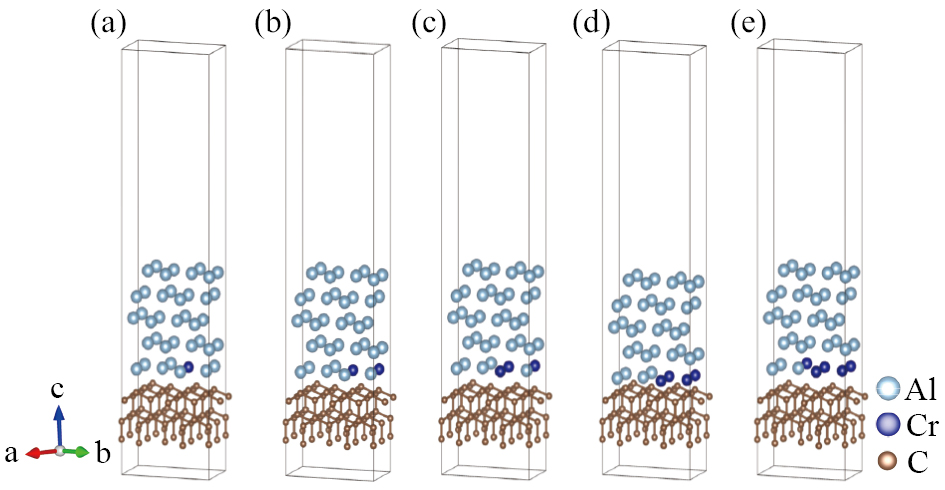
Fig. 2 Interface models of Al(111)/diamond(111) with different Cr doping concentrations:(a) 12.5%;(b) 25%;(c) 37.5%;(d) 50%;(e) 62.5%
2.2 界面黏附强度
界面结合强度可通过界面黏附功(work of adhesion,Wad)定量表征,其物理本质是将单位面积界面分离为自由表面所需的可逆功。黏附功越大,界面的结合强度越高,界面越稳定。计算公式为:
式(3)
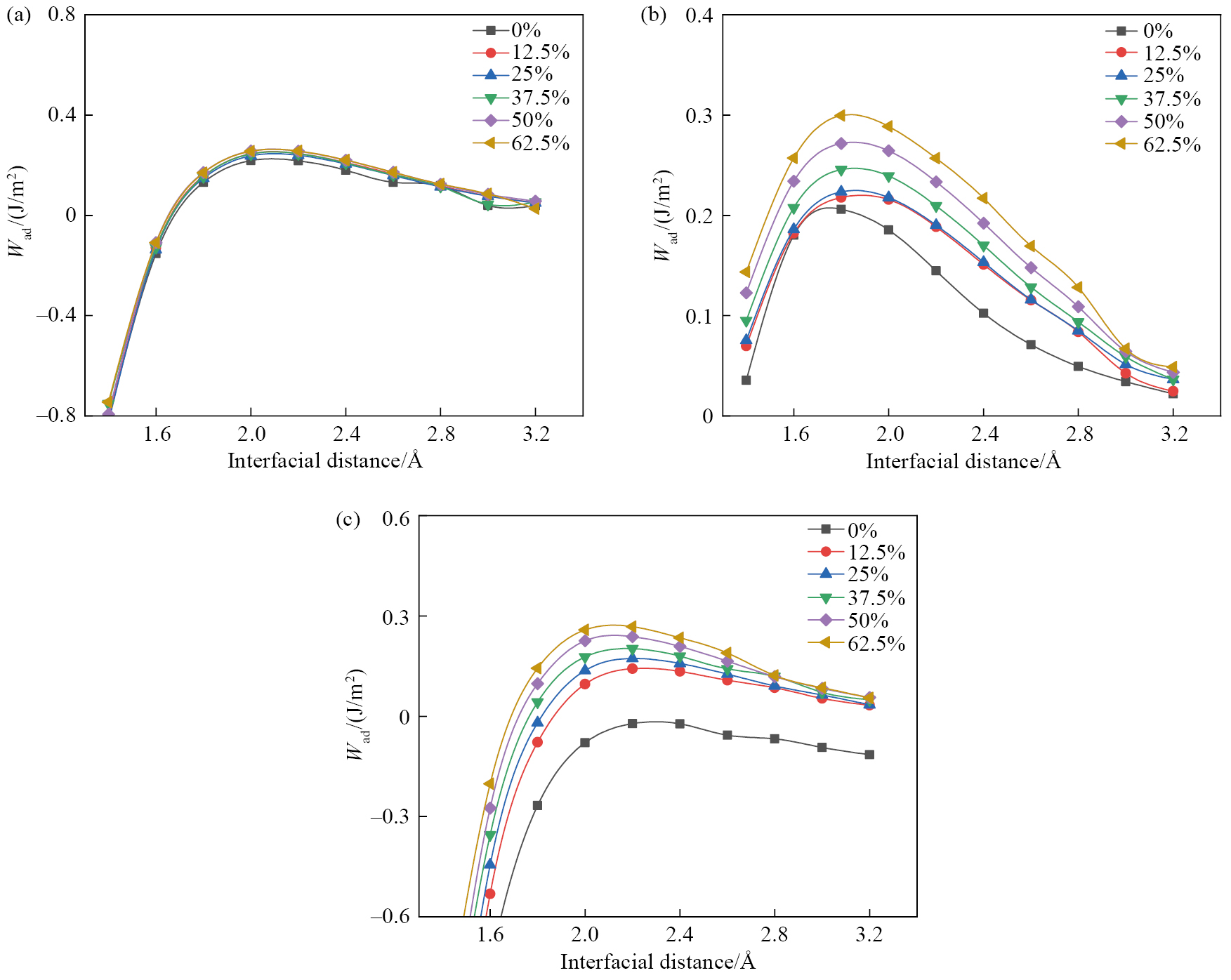
式中,Wad为黏附功,和分别是Al(111)、Cu(111)、Ag(111)与diamond(111)表面的能量。EA/B为Al(111)/diamond(111)、Cu(111)/diamond(111)、Ag(111)/diamond(111)界面模型的总能量。图3所示为不同浓度Cr掺杂Al(111)/diamond(111)、Cu(111)/diamond(111)、Ag(111)/diamond(111)界面的UBER(universal binding energy relation)曲线。根据UBER曲线可以拟合出最佳的界面距离和最佳的黏附功,拟合结果见表4。
Fig. 3 UBER curves of (a) Al(111)/diamond(111),(b) Cu(111)/diamond(111) and (c) Ag(111)/diamond(111) interfaces with different Cr doping concentrations
Table 4 Optimal interfacial distance and adhesion work of Al(111)/diamond(111),Cu(111)/diamond(111),Ag(111)/diamond(111) interfaces with different Cr doping concentrations
掺杂浓度(原子分数)
UBER
Al
Cu
Ag
d0/Å
Wad/(J/m2)
d0/Å
Wad/(J/m2)
d0/Å
Wad/(J/m2)
Cr-0%
2.049
0.278
1.799
0.206
2.249
0.019
Cr-12.5%
1.917
0.284
1.878
0.209
1.917
0.212
Cr-25%
1.943
0.285
1.865
0.231
1.969
0.232
Cr-37.5%
2.039
0.287
1.852
0.243
1.996
0.240
Cr-50%
2.000
0.292
1.813
0.250
2.039
0.239
Cr-62.5%
2.013
0.293
1.839
0.265
2.065
0.254
Cr掺杂在该体系中的作用主要表现为对已有键合结构的微调与优化,例如通过调制局部电子结构或缓解界面应力,进一步提升界面结合能力。Cr掺杂Al(111)/diamond(111)界面模型的黏附功随掺杂浓度增加的提升幅度相对有限。而Cr元素掺杂Cu(111)/diamond(111)和Ag(111)/diamond(111)界面模型随掺杂浓度的增加,界面结合能力提升显著。本研究计算的浓度依赖性趋势与Yamanaka等[ Yamanaka T,Morimoto S,Kanda H. Influence of the isotope ratio on the lattice constant of diamond [J]. Physical Review B,1994,49(14):9341-9343. 29]和Qiu等[ Qiu W Q,Liu Z W,He L X,et al. Improved interfacial adhesion between diamond film and copper substrate using a Cu(Cr)-diamond composite interlayer [J]. Materials Letters,2012,81:155-157. 30]的实验观察高度吻合,即使在微量Cr掺杂[0.05%~0.1%(质量分数)]条件下,Cu/diamond界面结合性能已获得显著改善,表明Cr元素对界面结合能力具有高效强化特性。
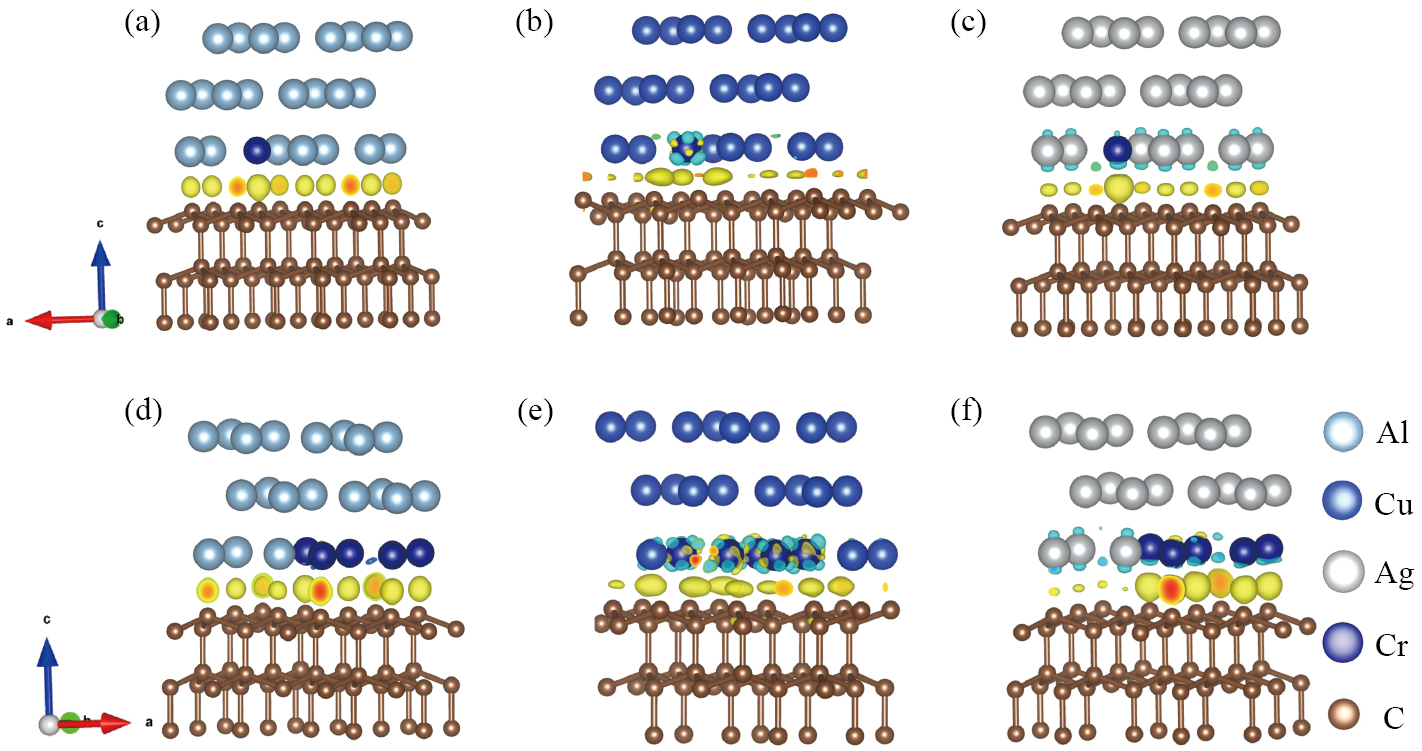
Fig. 4 Charge density difference maps of (a,d) Al(111)/diamond(111),(b,e) Cu(111)/diamond(111) and (c,f) Ag(111)/diamond(111) interfaces doped with atomic fraction of 12.5% Cr and 62.5% Cr,respectively
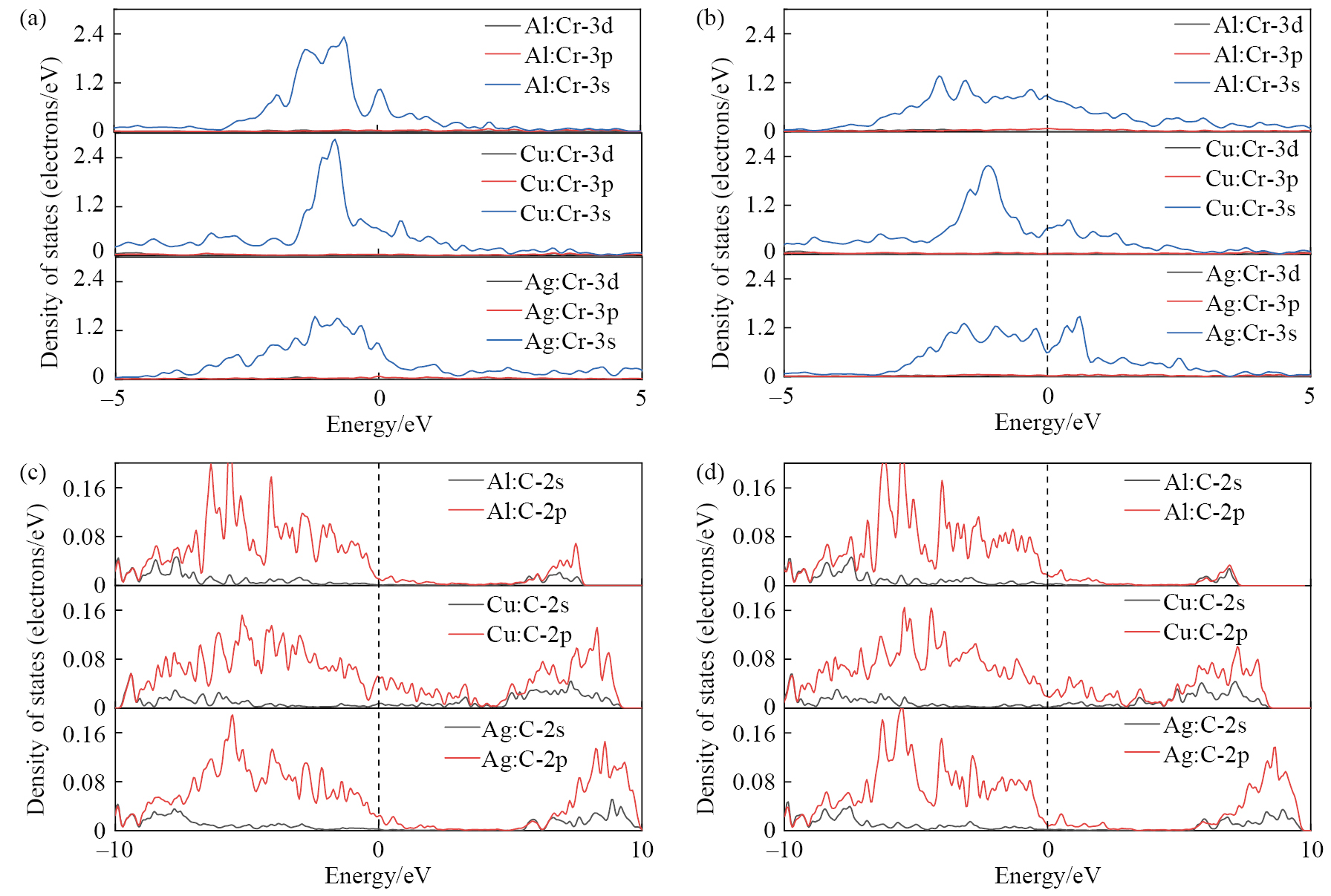
Fig. 5 Projected density of states (PDOS) with atomic fraction of (a) 12.5% Cr, (b) 62.5% Cr, (c) 12.5% C and (d) 62.5% C in the Al(111)/diamond(111),Cu(111)/diamond(111) and Ag(111)/diamond(111) systems
近年来,第一性原理计算已被广泛应用于金属/金刚石界面的研究。Han等[ Han J,Yang X,Ren Y,et al. Effects of alloying elements on diamond/Cu interface properties based on first-principles calculations [J]. Journal of Physics:Condensed Matter,2023,35(11):115001. 11]系统研究了多种合金元素(Ti、Zr、Cr、Mo、W等)对Cu/diamond(111)界面的影响,发现Cr是有效的强化元素,但其研究集中于单一掺杂浓度,未探讨浓度梯度效应。Gu等[ Gu K X,Pang M J,Zhan Y Z. Insight into interfacial structure and bonding nature of diamond(001)/Cr3C2(001) interface [J]. Journal of Alloys and Compounds,2019,770:82-89. 12]深入分析了diamond(001)/Cr3C2(001)界面的成键本质,揭示了Cr-C键的强杂化特性,但其研究关注的是碳化物/金刚石界面,而非金属/金刚石界面中低浓度Cr掺杂的调控作用。Zhu等[ Zhu P,Zhang Q,Xia Y X,et al. Unveiling the interface characteristics of diamond/Al interface:First-principles calculations and experiments [J]. Applied Surface Science,2025,685:161969. 7]通过计算与实验结合,系统研究了Al/diamond界面的本征特性,但未涉及过渡金属掺杂的影响。
CaoY X,WuM,FangY,et al. The effects of alloying elements on the bonding strength of diamond/carbide/Cu interface based on first-principles calculations [J]. Physica Status Solidi (b), 2023, 260(9):2300059.
[5]
BaiG Z,WangL H,ZhangY J,et al. Tailoring interface structure and enhancing thermal conductivity of Cu/diamond composites by alloying boron to the Cu matrix [J]. Materials Characterization,2019,152:265-275.
[6]
LiuZ J,ZhengS X,LuZ B,et al. Adhesive transfer at copper/diamond interface and adhesion reduction mechanism with fluorine passivation:a first-principles study [J]. Carbon,2018,127:548-556.
[7]
ZhuP,ZhangQ,XiaY X,et al. Unveiling the interface characteristics of diamond/Al interface:First-principles calculations and experiments [J]. Applied Surface Science,2025,685:161969.
JhongY S,HsiehM C,LinS J. Effect of Ag/Cu matrix composition on thermal properties of diamond/Ag/Cu-Ti composites fabricated by pressureless sintering [J]. Materials Letters,2019,254:316-319.
[10]
LiuX Y,WangL H,ZhangY J,et al. Microstructural evolution of sandwiched Cr interlayer in Cu/Cr/diamond subjected to heat treatment [J]. Thin Solid Films,2021,736:138911.
[11]
HanJ,YangX,RenY,et al. Effects of alloying elements on diamond/Cu interface properties based on first-principles calculations [J]. Journal of Physics:Condensed Matter,2023,35(11):115001.
[12]
GuK X,PangM J,ZhanY Z. Insight into interfacial structure and bonding nature of diamond(001)/Cr3C2(001) interface [J]. Journal of Alloys and Compounds,2019,770:82-89.
[13]
WuZ G,CohenR E. More accurate generalized gradient approximation for solids [J]. Physical Review B,2005,73(23):235116.
[14]
XieH N,ChenY T,ZhangT B,et al. Adhesion, bonding and mechanical properties of Mo doped diamond/Al(Cu) interfaces:a first principles study [J]. Applied Surface Science,2020,527:146817.
[15]
ZhangH L,QiY X,LiJ W,et al. Effect of Zr content on mechanical properties of diamond/Cu-Zr composites produced by gas pressure infiltration [J]. Journal of Materials Engineering and Performance,2018,27(2):714-720.
[16]
KealT W,TozerD J. A semiempirical generalized gradient approximation exchange-correlation functional [J]. Journal of Chemical Physics,2004,121(12):5654-5660.
[17]
StachiottiM G. First-principles study of the adsorption of NH3 on Ag surfaces [J]. Physical Review B,2009,79(11):115405.
WuZ X,PangM J,ZhanY Z,et al. The bonding characteristics of the Cu(111)/WC(0001) interface: an insight from first-principle calculations [J]. Vacuum,2021,191:110218.
[21]
ZhangJ H,WangA Q,LiangT T,et al. The prediction of Al2Cu/Cu interfacial structure and properties:a first-principles study [J]. Physica B:Condensed Matter,2023,661:414931.
[22]
OtteH M. Lattice parameter determinations with an X-ray spectrogoniometer by the Debye-scherrer method and the effect of specimen condition [J]. Journal of Applied Physics,1961,32(8):1536-1546.
YadavS K,RamprasadR,WangJ,et al. First-principles study of Cu/TiN and Al/TiN interfaces:weak versus strong interfaces [J]. Modelling and Simulation in Materials Science and Engineering,2014,22(3):035020.
OwnbyP D,YangX,LiuJ. Calculated X-ray diffraction data for diamond polytypes [J]. Journal of the American Ceramic Society,1992,75(7):1876-1883.
[29]
YamanakaT,MorimotoS,KandaH. Influence of the isotope ratio on the lattice constant of diamond [J]. Physical Review B,1994,49(14):9341-9343.
[30]
QiuW Q,LiuZ W,HeL X,et al. Improved interfacial adhesion between diamond film and copper substrate using a Cu(Cr)-diamond composite interlayer [J]. Materials Letters,2012,81:155-157.